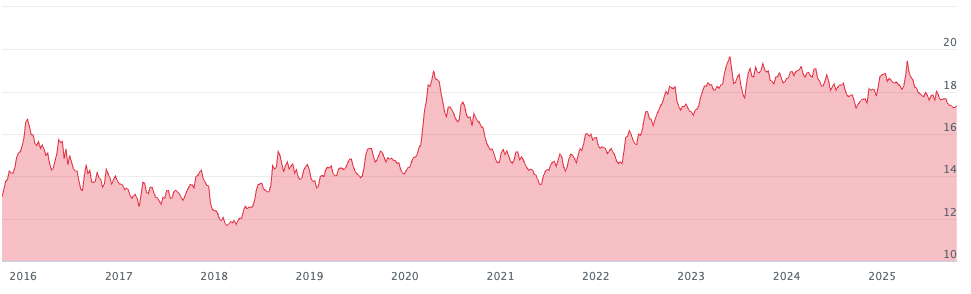


South African Reserve Bank (SARB) Governor Lesetja Kganyago says the rand is incredibly undervalued, with studies showing that the rand should be around R7 to the dollar.
Speaking before the Kgalema Motlanthe Foundation Drakensberg Inclusive Growth Forum, Kganyago highlighted that the rand has depreciated over the past two decades.
Although the governor highlighted the Mundell−Fleming framework, which suggests that currency depreciation should lead to growth, the rand has weakened over the last 10 years, while the economy has weakened.
“Indeed, back in the late 2000s, it was often argued that South Africa’s real exchange rate was too strong and too volatile. This indicator has since become significantly weaker and less volatile.”
“If you consider indicators of purchasing power parity, such as the simple Big Mac Index, you see that for the rand to have the same buying power in the US as it does here, the exchange rate would need to be around 50−60% stronger.”
He added that more sophisticated measures of purchasing power parity, which go beyond simply the cost of a Big Mac, suggest that equal buying power would require an exchange rate close to R7 per dollar.
This was in reference to the World Bank’s purchasing power parity conversion factors.
While the World Bank noted that the rand should have traded at R7.4 to the dollar last year, the actual exchange rate was R18.3 to the dollar.
The governor explained that the missing growth relationship of the currency may reflect larger developments in the country, in a similar way that a share price reflects the health of a company.
“If a country looks good, investors are impressed, and the currency appreciates. By the same token, if they lose confidence, they sell.”
“When you have good news stories, such as structural reforms, fiscal discipline and effective governance, you get growth, and at the same time you get currency gains.”
“When you have bad news stories, such as state capture, unsustainable debt growth and junk status, growth weakens and the currency follows suit.”
On top of this, he noted that growth also benefits from imports and exports.
He noted that many exporters will still import components, with capital goods for investments also often imported.
“This may help explain why many emerging markets tend to invest more when their currencies are stronger, and this extra investment raises growth,” he said.
“That does not mean you should aim for the strongest exchange rate possible, of course. But it does suggest a balanced approach that also considers the benefits of imports.”
New target

Kganyago added that South Africa has committed to a free-floating exchange rate for 27 years, and that it might be time for the currency to mature to a new stage.
A key driver is the shift towards permanently lower inflation, which the Reserve Bank has publicly pushed for since last year.
South Africa’s current inflation target ranges from 3% to 6%, with the Monetary Policy Committee (MPC) instructed to aim for the midpoint of 4.5%.
In July, Kganyago announced that the MPC would deviate from the 4.5% midpoint target and try to keep inflation at around 3%.
Although the MPC tries to reach the target, the Minister of Finance, Enoch Godongwana, has the power to change the target.
Despite initial tensions between the SARB and National Treasury over the move, the two parties are working together to set a new target, with both aggreeing that the current target range is too wide.
“As we have often argued, our inflation rate is out of line with our peers and competitors,” said Kganyago.
“Unfortunately, if you aim for a high inflation rate, you end up raising prices faster than other countries.”