

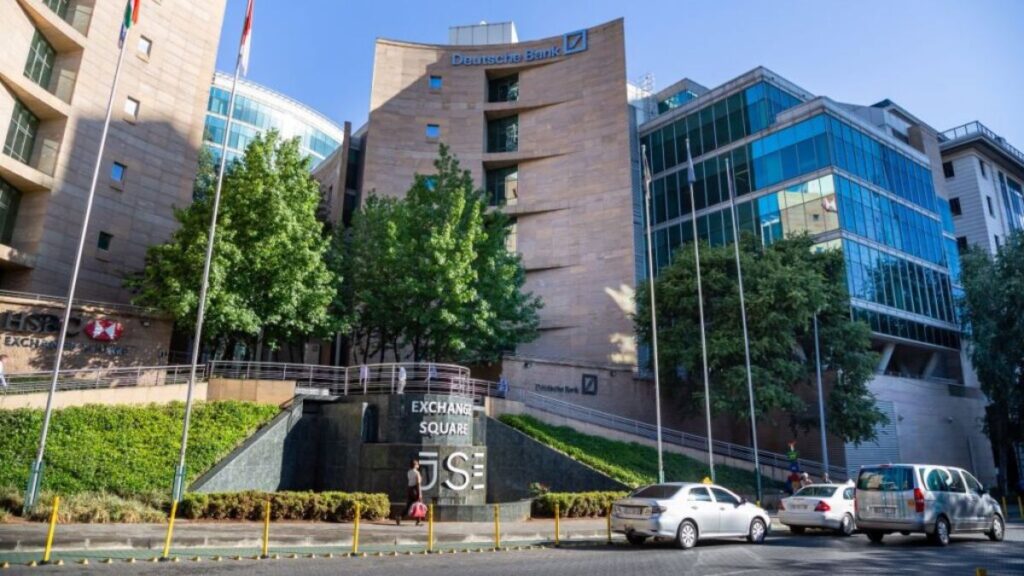
The Johannesburg Stock Exchange, a 138-year-old institution that has long dominated South Africa’s financial markets, is now facing the possibility of a record-setting penalty.
The Competition Commission wants the JSE fined 10% of its annual turnover after accusing it of using its power to block rival exchange A2X from growing.
The case began when A2X filed a formal complaint in October 2022. Competition Commission spokesperson Siyabulela Makunga said the alternative exchange was launched in 2017.
He added that A2X alleged that the JSE used various forms of exclusionary conduct to slow its expansion in the secondary trading market.
A2X entered a space historically controlled by the JSE to bring more competition to South Africa’s capital markets.
Makunga said the Commission’s investigation found that A2X struggled to gain trading volumes because it could not easily connect with the JSE’s systems.
Since the JSE houses South Africa’s primary listings, brokers trading across markets need to interact with the JSE to buy and sell the same shares on multiple platforms.
According to Makunga, this is where the JSE made things difficult. “An exchange in a secondary market requires a sufficient interaction with the JSE trading system,” he explained.
If brokers cannot execute trades smoothly across both markets, the process becomes slow, complicated, and more expensive—problems that hit smaller and historically disadvantaged brokers the hardest.
The Commission believes the JSE created obstacles that “starved A2X of trading volumes” and protected its dominant position.
The key issue is the JSE’s Broker Dealer Accounting (BDA) system, which brokers must use to allocate trades.
Makunga said the JSE not only enforced mandatory use of the BDA system but also failed to ensure that it worked well with A2X’s systems.
This created barriers for brokers who needed to allocate trades across the two platforms in a simple, efficient way.
A deliberate strategy from the JSE

With these findings, the Commission has referred the case to the Competition Tribunal, where the JSE must defend itself or risk one of the largest fines ever proposed in South Africa.
“The Commission strongly believes that there is a case to answer,” Makunga said. A2X CEO Kevin Brady added that the BDA system is at the heart of the problem.
In most markets, exchanges set technical standards and let brokers choose any system that meets those standards.
However, the JSE’s BDA system is a closed system that other platforms cannot access or integrate with easily. “You can’t have a mandated system that’s closed,” Brady argued.
Brady explained why this matters in practical terms. Brokers often need to combine trades across markets—for example, buying shares on the JSE and A2X and grouping them into one transaction.
He added that the system even treats some trades differently, allowing certain transactions to move from A2X to the JSE but blocking the reverse.
“This is not a regulatory issue. This is a deliberate strategy from the JSE to make it difficult for brokers to easily and seamlessly trade and allocate across markets,” he said.
Brady also believes South Africa’s broader regulatory framework is outdated compared to markets in Europe, India, and the United States.
Reforms are being drafted, including new conduct standards and the long-delayed Financial Markets Review, but these changes are expected to take years.
Until then, he said that the Competition Commission’s case is necessary. “They’ve done their homework.”
Makunga added that the Commission is focused on fairness and creating a market where newer and smaller brokers can participate fully.
“We are preoccupied with levelling the playing field,” he said. Efficient and open markets, he argues, create opportunities for broader participation, economic growth, and job creation.
The JSE said it has acknowledged the Commission’s referral and is preparing its plea, which it plans to file in early 2026. It cannot yet say when or whether the case will go to trial.
