

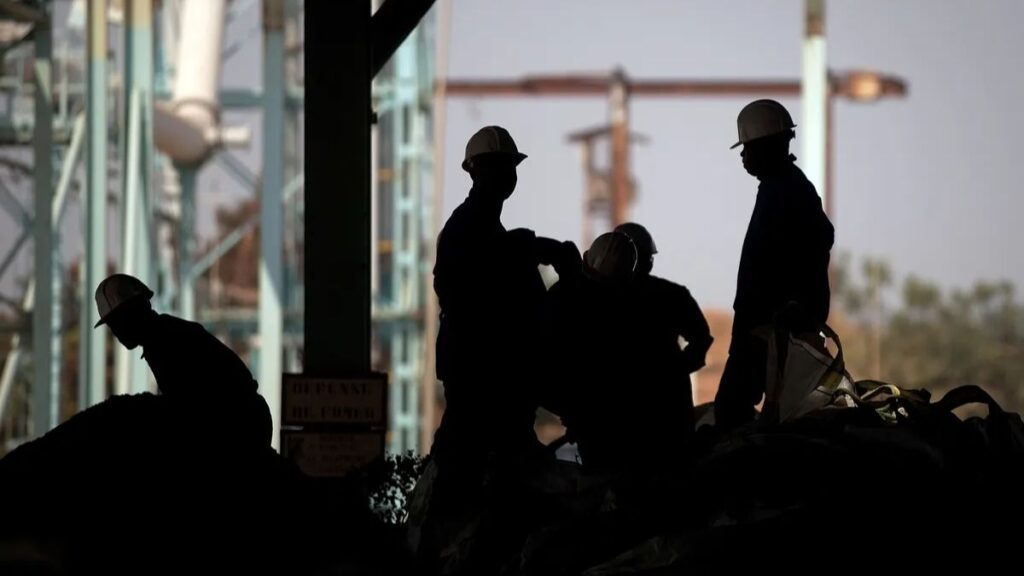
Glencore’s ferrochrome venture in South Africa is preparing to shut down two major smelters and cut jobs after more than 20 years in the country, citing electricity costs that have become impossible to sustain.
The company, which runs the Glencore-Merafe Chrome Venture with Merafe Resources, said it will idle its Boshoek and Wonderkop smelters from 1 January.
Retrenchment notices and voluntary severance packages were issued to workers from 1 December. If no government-backed solution is found, the cuts become final on 9 December.
The venture, established in July 2004, grew into the world’s largest ferrochrome producer after Glencore and Merafe combined their chrome operations.
Today, however, the industry is struggling. The country lost its global lead to China in 2012 due to unreliable electricity supply and rapidly rising tariffs.
Glencore did not say how many jobs would be affected. However, the venture employs nearly 3,000 people on the smelting side of its business, and trade union Solidarity noted that approximately 2,400 employees is affected by this.
Its announcement follows another major warning from Samancor Chrome, which recently said it may cut up to 2,496 jobs as it considers closing or shrinking operations for the same reason.
Professor Sampson Mamphweli, head of the Energy Secretariat at the South African National Energy Development Institute, said the price of electricity has gone up by more than 900% since 2008.
For smelters, this is catastrophic. He explained that producing ferrochrome requires about 4 megawatt hours per ton of metal, making electricity their single biggest cost.
Under these conditions, South African smelters simply cannot compete with countries like China, where electricity is kept deliberately cheap to attract industrial production.
“China has offered their smelters a very low electricity price to attract them,” he said.
Mamphweli stressed that while Eskom cannot easily offer discounted tariffs because its own costs are high, alternative solutions must be explored.
He believes renewable energy could help, but only if South Africa expands its grid so that renewable power can reach smelters consistently.
“Renewable energy can play a very big role if we have enough grid capacity,” he said. Independent power producers could supply smelters directly, but grid constraints and wheeling limitations still stand in the way.
Also bad news for Eskom

The decline of smelting operations also threatens Eskom’s financial stability. Smelters are among its biggest and most reliable customers.
“They are a paying customer,” Mamphweli said, arguing that Eskom should be able to offer slightly lower tariffs because of the massive volumes they consume. Losing them, he warned, would further weaken an already struggling utility.
Eskom has been selling less electricity due to load-shedding, rising tariffs, and the rapid growth of rooftop solar, while many municipalities owing nearly R100 billion and are not paying reliably.
Government has already intervened in some cases. Mamphweli said Minister Kgosientsho Ramokgopa introduced policy changes, approved by Cabinet, that enabled Eskom to make new electricity pricing offers to several smelters.
One of these included in the negotiations was Glencore’s large Boshoek plant—the biggest smelter in the country. Its closure would be devastating.
“If they close down, you’re looking at job losses upward of 2,000 people,” he said. Boshoek produces about 2.3 million tons of ferrochrome a year, roughly a third of South Africa’s total exports.
Across the industry, the losses are already immense. “We’ve lost between 300,000 and 400,000 jobs,” Mamphweli said. He warned that the sector cannot withstand more closures.
Despite Eskom’s consultations, Willie Venter, Deputy General Secretary for the Metal and Engineering Industry at Solidarity, said the government has not done enough to avert this crisis.
“On the contrary, the government has renounced further mediation with Solidarity and has therefore caused the situation now unfolding,” he said.
“The notices at Samancor and now Glencore show how urgently intervention is needed to save thousands of South Africans from unemployment.”
He added that in recent discussions with the government at Nedlac, Solidarity and employers clearly outlined the situation.
However, he noted that pleas for lower electricity prices to continue production at the smelters have been ignored.
