


The City of Cape Town has comfortably created the most housing units across South Africa’s metros, but is facing severe housing issues.
Stats SA said that the nation’s metros develop their residential landscape in their own, unique way, ranging from free-standing homes to high-density upward housing.
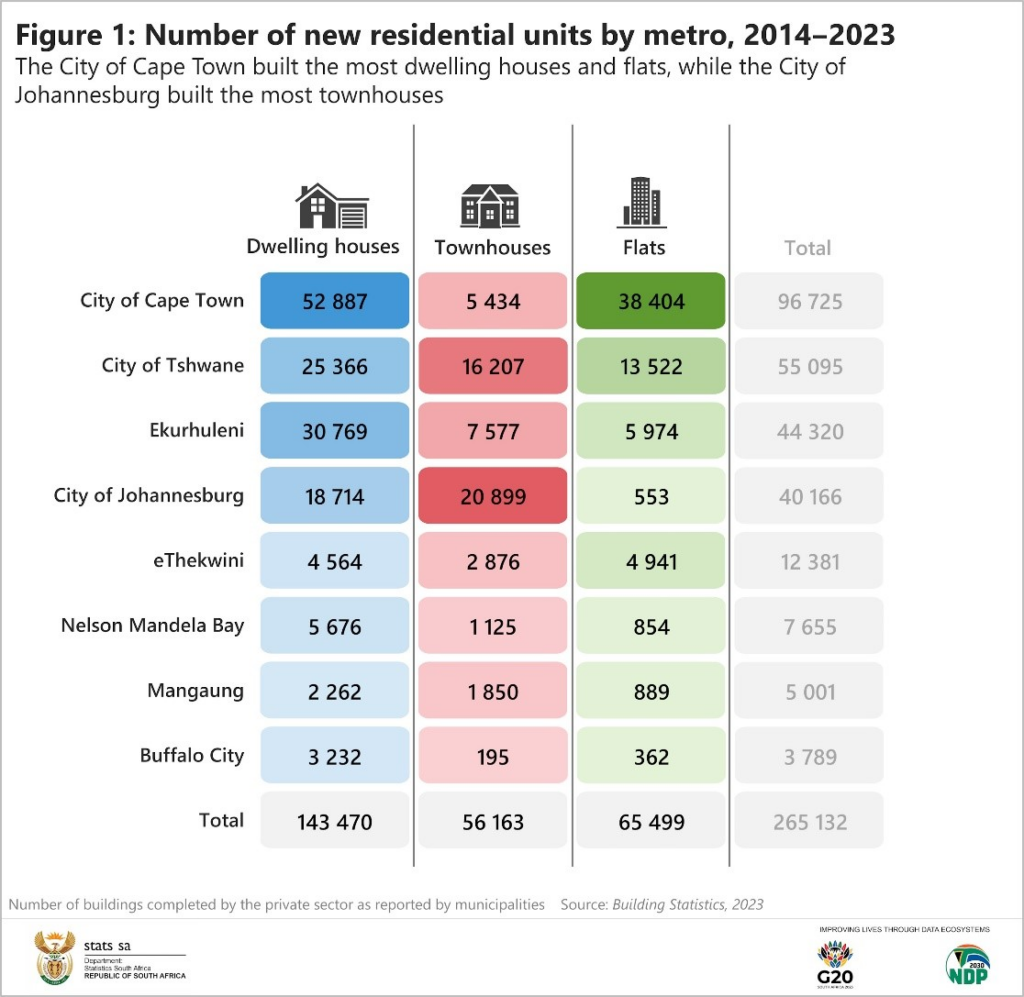
Stats SA’s latest ten-year review of private sector building statistics shows that the City of Cape Town was the most active metropolitan municipality during the period 2014 to 2023.
The metro saw the completion of the most dwelling houses and flats, as well as the fourth-largest number of townhouses.
Overall, the city recorded just under 97,000 new housing developments over the period. This was comfortably ahead of second-placed City of Tshwane at 56,000.
The City of Johannesburg was fourth overall, but did record the most townhouse builds at 20,900.
Notably, flats don’t seem very popular in the City of Johannesburg, accounting for only 1% of new residential units.
Whereas flats accounted for 40% of new residential units in both the City of Cape Town and eThekwini.
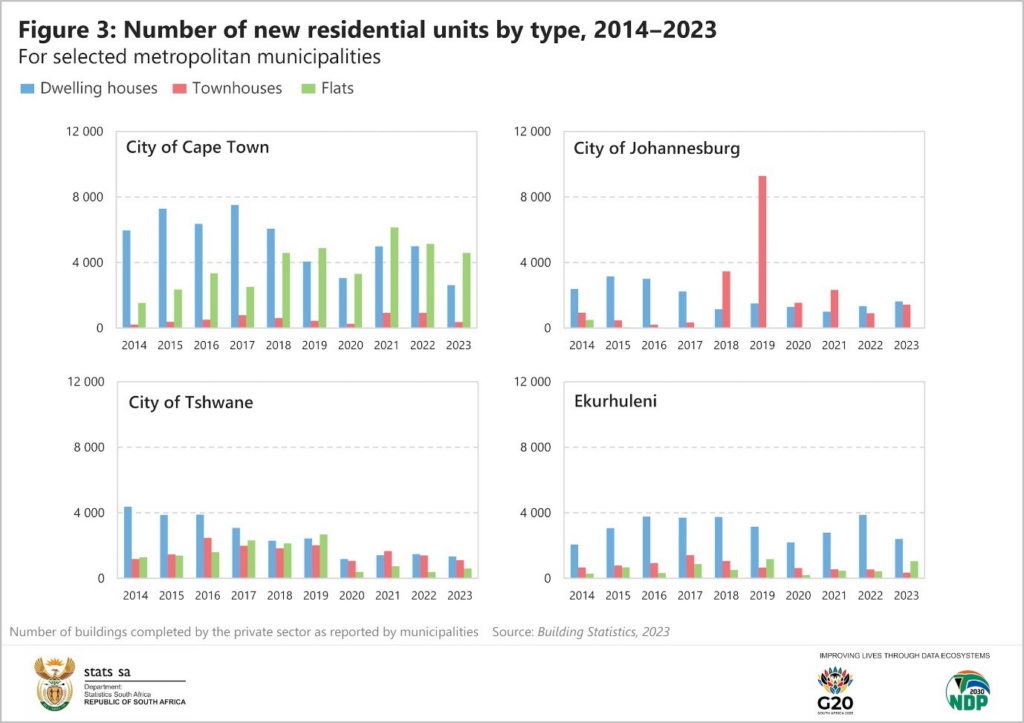
Notably, Stats SA data also showed a notable shift in residential development in the City of Cape Town from dwelling houses to flats.
In the City of Johannesburg, there has been a significant shift towards townhouses, accounting for a substantial share of private-sector residential development in the municipality since 2018.
Affordability crisis
According to Property24, the average selling price in Cape Town has risen from around R1.5 million in 2016 to R2.1 million in 2025. This comes despite a weak macroeconomic environment in South Africa.
Part of this rapid house price inflation has been linked to a shortage of houses in the area.
Speaking with Politically Aweh, Cape Town Mayor Geordin Hill Lewis said that the city’s housing backlog now sits at about 600,000 homes.
This has been exacerbated by a significant decline in national housing grants and the semigration of 100,000 families from Gauteng over the last two years.
In addition to the housing shortage, the growth of Airbnb in Cape Town is also considered a major factor contributing to the city’s rising property prices.
Cape Town, like many other popular tourist destinations, has seen a rise in property owners opting for short-term rentals, which can drive up demand and prices.
The rise of wealthy buyers in the city has also increased tension from residents of the city, who claim to be priced out of their own city.
Case in point is Kalk Bay on the West Coast of False Bay, whose fishing industry has been replaced by tourism.
Due to a plethora of old buildings, trendy restaurants, art galleries and bohemian boutiques, the town has seen an influx of wealthy buyers and investors.
Areas across False Bay have seen house prices rise by as much as 150% by 2025, driven by residential and investment buyers, including Airbnb.
Data from Seeff Property and Lightstone shows that full-title house prices in Kalk Bay rose from R4.9 million in 2020 to R9 million by early 2025—an over 80% increase.
Rising municipal rates and property valuations are putting these long-term residents under pressure.
