


President Cyril Ramaphosa says that, despite multiple operational and financial troubles the South African National Defence Force (SANDF) faces, the soldiers are vital guardians of order in the country.
The president announced in his State of the Nation Address (SONA) earlier this month that he would deploy the military to take on organised crime, gang violence and illegal mining in the country.
While the move has received some support from opposition political parties, including the Democratic Alliance and the Economic Freedom Fighters, it has also drawn a fair share of criticism.
Academics, in particular, have pointed out that such action is ineffective for the long-term stability of areas where soldiers are deployed, and that the deployment itself is only a temporary solution that ignores the deep-rooted issues causing the problems.
Ramaphosa has hit back at critics and defended the move, saying that exceptional solutions are required in exceptional circumstances.
He added that the measure is not taken lightly.
“Given our history, where the apartheid state sent the army into townships to violently suppress opposition, it is important that we do not deploy the SANDF inside the country to deal with domestic threats without good reason,” he said.
“This recent deployment has become necessary due to a surge in violent organised crime that threatens the safety of our people and the authority of the state.”
He stressed that the SANDF will be deployed in support of the SAPS, operating under police command, with clear rules of engagement and for specific time-limited objectives.
The SANDF may, for example, be called on by the police to provide protection in high-risk operations, or to support cordon-and-search operations against armed criminals, he said.
“Soldiers may also help to secure critical infrastructure, freeing SAPS members to focus on investigations, arrests and building cases that lead to successful prosecutions.”
Ramaphosa added that the army deployment isn’t a one-shot solution and that it is happening alongside other measures aimed at tackling the problems more directly.
This includes strengthening anti-gang units and illegal mining task teams.
“The police will also be working with the National Prosecuting Authority on multi-disciplinary task teams to target the leadership, finances, firearms and logistics of these criminal networks,” he said.
Not the first time
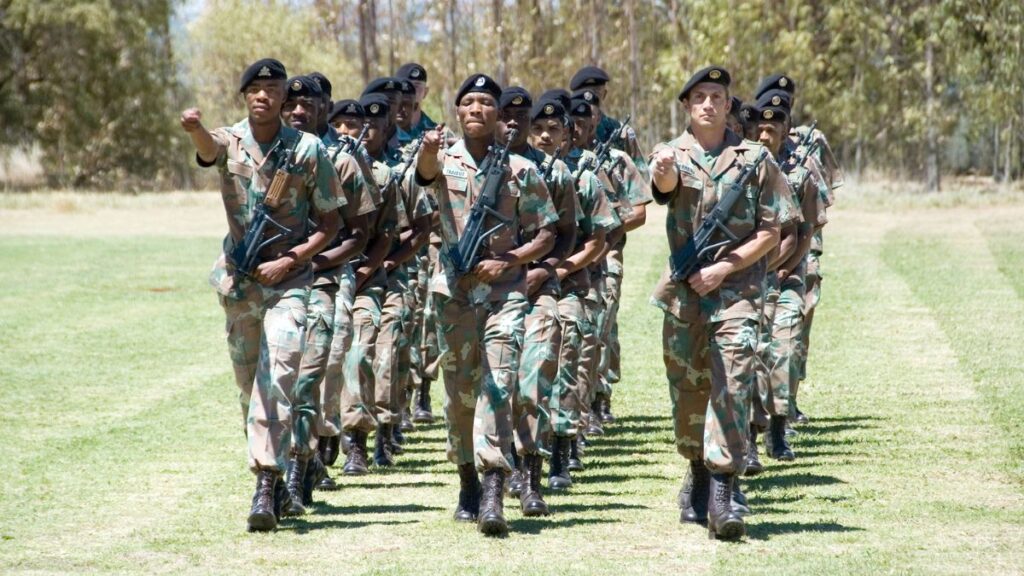
Ramaphosa said that the role of the SANDF has evolved over time, and that internal deployment has become a critical measure to not only maintain security, but also to deal with disasters.
Recently, during the floods in parts of Limpopo and Mpumalanga, the SANDF supported relief efforts, assisted with evacuations, repaired damaged infrastructure, and erected temporary structures.
The SANDF also provided healthcare services to more than 50,000 people in underserved communities.
“Over the last few years, the SANDF has helped improve the lives of rural communities. It has conducted law-enforcement operations at our borders to curb people smuggling, illicit activity and illegal crossings,” he said.
Looking further back, the SANDF was also mobilised during the COVID-19 pandemic, which he said enabled the government to “enforce disaster regulations, safeguard our borders, support anti-crime efforts with the SAPS and set up field hospitals to tend to the sick”.
The president acknowledged that the SANDF is operating amid significant challenges, including financial constraints due to the poor state of public finances.
“As our financial position stabilises, we are working to close funding gaps and strengthen the readiness of our armed forces,” he said.
To temper concerns about South Africa becoming a military state, the president stressed that, unlike the SANDF before 1994, the army today is subject to civilian oversight and reflects the diversity of the country.
“They operate in strict adherence with international humanitarian law” and the Constitution, he said.
