

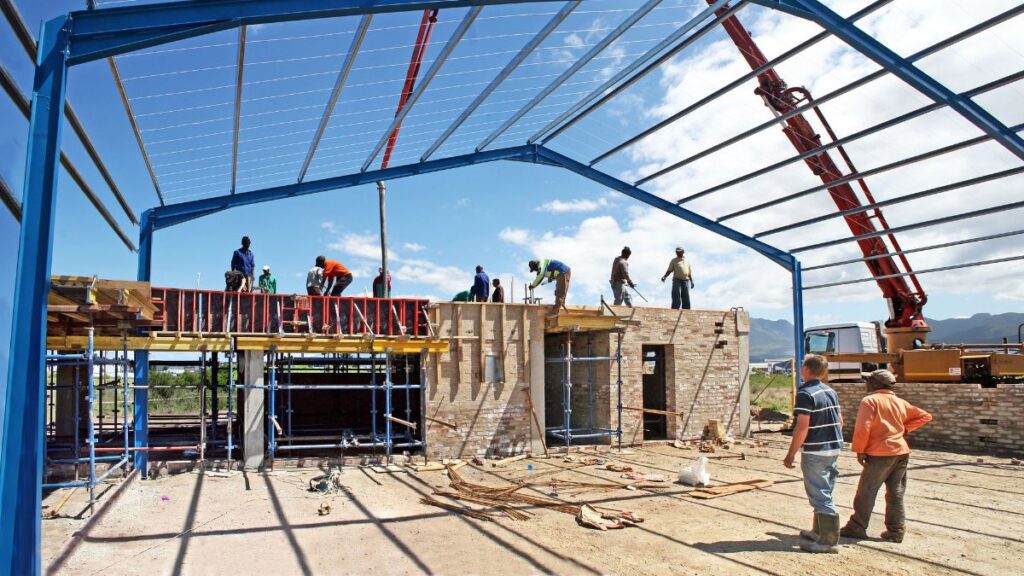
Late payments by the government are choking the life out of South Africa’s construction sector, one of South Africa’s largest employers.
This is the feedback from Euan Massey, director at construction experts MDA Attorneys, who said contractors are increasingly being forced to finance projects out of their own pockets—threatening their survival.
According to a report published by the International Labour Organisation, South Africa’s construction sector employs approximately 1.2 million people across the country.
The National Treasury’s latest payment data points to a worsening late payment crisis across national and provincial government departments.
At the end of the second quarter of 2025, 95,399 invoices older than 30 days, totalling R12.4 billion, remained unpaid.
Massey said the problem has become severe across the construction industry, particularly in the public sector, where there is widespread non-compliance with existing legislation requiring payment within 30 days.
“It’s a real problem. We’re at the coalface of a number of these particular payment issues. There’s legislation in place, but unfortunately, particularly in the public sector, there’s large amount of non-compliance,” said Massey.
As a result, contractors are often left to fend for themselves when it comes to collecting what they are owed.
“Contractors are really left to their own devices to collect money, and to be innovative in doing that,” Massey said.
He warned that the situation is having a profound impact, especially on smaller firms that lack the financial capacity to carry projects for extended periods.
He blamed the ongoing delays largely on inefficiencies within government departments.
“I just think it’s largely incompetence. Payments in a number of government departments just don’t take place within these periods of time,” he said.
The practical implications for contractors are severe. Massey explained that when payments are delayed, companies struggle to keep projects running.
“Whilst you’re busy with the project that you’re executing, you can’t buy materials, you can’t pay your subcontractors, you can’t pay your labour in some instances, and that brings these projects to a grinding halt,” he said.
This has contributed to the slow pace of infrastructure delivery in the country, with projects dragging on for years or even decades.
Quality also suffers

While safety standards are generally maintained, Massey warned that quality can suffer when contractors are under financial strain.
“Most contractors would not compromise safety, but most certainly on quality. When people aren’t paid, the quality does drop off,” he said.
He added that the current situation effectively forces contractors to bankroll public infrastructure—something he described as untenable.
Despite these challenges, contractors continue to bid for government work, largely because of the need to sustain their businesses.
“You’re making some money on some [projects] and losing on others, and hopefully, in the balance, everything’s going to be okay,” he explained.
Massey also highlighted structural changes in the industry, including the growing use of EPC (engineering, procurement and construction) contracts, which place greater responsibility and risk on contractors.
While effective and “bankable,” particularly for private-sector projects like renewable energy, he said local firms have sometimes underestimated the risks involved, “with fairly severe consequences.”
At the same time, increasing competition from international firms is adding further pressure.
“There’s increased international competition, particularly from China, Europe, and India,” he said, and noted that the government often appears to favour foreign contractors over developing local capacity.
To stabilise the sector and support the government’s infrastructure ambitions, Massey called for urgent reform, particularly of payment systems.
He pointed to previously proposed “Prompt Payment regulations” as a potential solution. These would enforce strict payment timelines and introduce fast-track dispute resolution mechanisms.
“Something along those lines would need to be introduced. We’ve seen it in a number of other countries, and it works with great success,” he said.
