

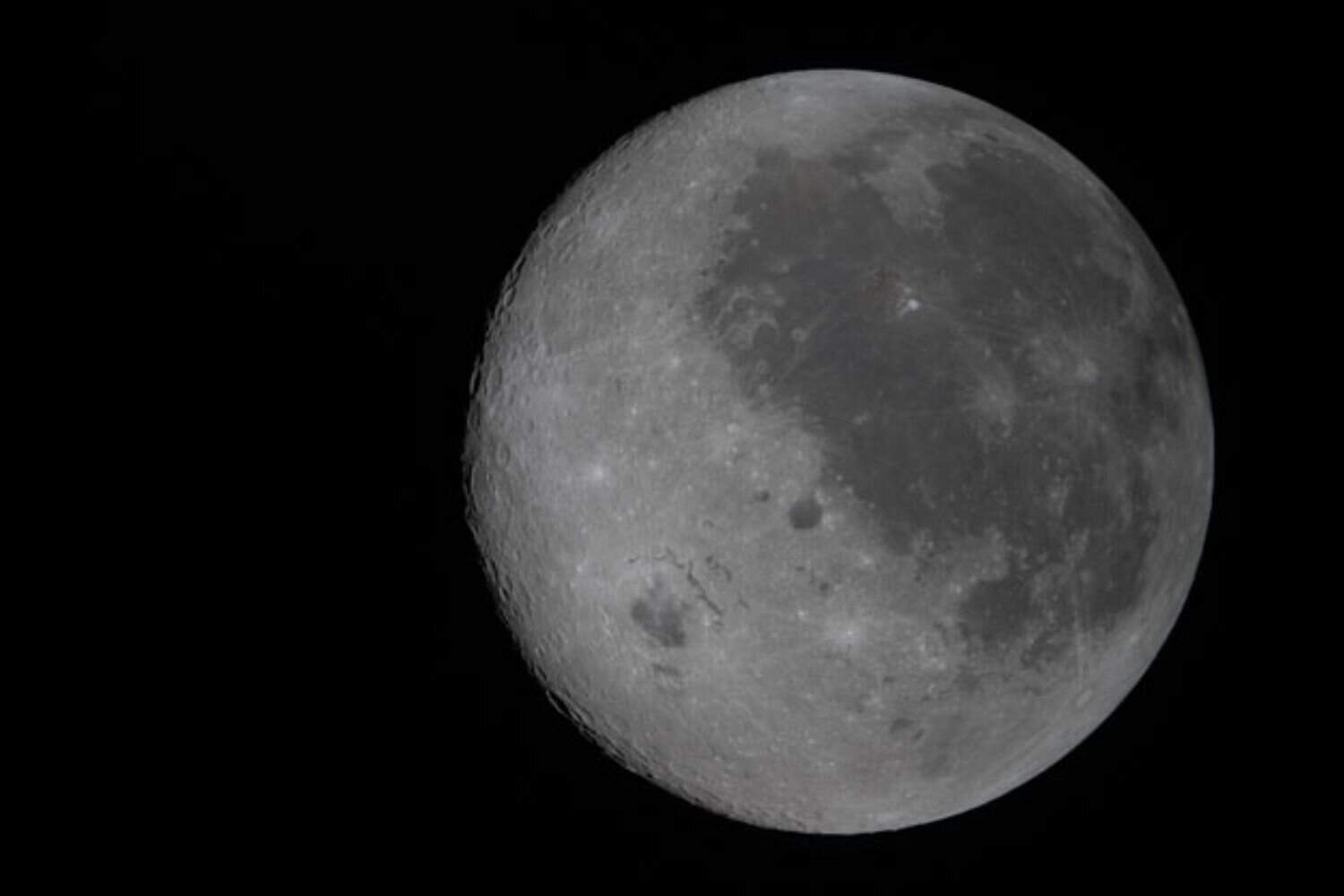
At its farthest point, the crew inside the Orion spacecraft travelled about 406 771km away from Earth
Four astronauts aboard NASA’s Artemis II test flight around the Moon made history, travelling 400 171km from Earth, surpassing the record for human spaceflight’s farthest distance previously set by the Apollo 13 mission in 1970.
At its farthest point, the crew inside the Orion spacecraft reached about 406 771km from Earth at 12:56 pm Central Daylight Time on Monday, 6 April, before looping back towards Earth, setting a new record for human spaceflight.
Moon mission
Six days into the first crewed mission of NASA’s Artemis program, astronauts Reid Wiseman, Victor Glover, and Christina Koch, and Canadian Space Agency astronaut Jeremy Hansen continued collecting pictures of the Moon on their voyage away from Earth.
“It is so great to hear from Earth again,” said Koch, as the crewmembers were once again able to speak with humans on their home planet.
“We will always choose Earth, we will always choose each other.”
ALSO READ: Africa eyes lunar race as NASA prepares Artemis II mission to the moon
Heading home
The Orion capsule is zipping around the Moon before U-turning and heading back to Earth on a so-called “free-return trajectory,” a return trip that will take about four days.
“At NASA, we dare to reach higher, explore farther, and achieve the impossible. That’s embodied perfectly by our Artemis II astronauts.
“They are charting new frontiers for all humanity,” said Dr Lori Glaze, acting associate administrator for Exploration Systems Development Mission Directorate at NASA Headquarters in Washington.
“Their dedication is about more than breaking records – it’s fueling our hope for a bold future. Their mission is carrying our promise to return to the Moon’s surface, this time to stay as we establish a Moon Base.”
NASA Artemis passing close to the Moon pic.twitter.com/jLvGoW1IR9
– Elon Musk (@elonmusk) April 7, 2026
Naming craters
In addition to their spaceflight record, the crew suggested naming two craters on the Moon during their flight.
The first is named in honour of their spacecraft, Integrity. The second honours Wiseman’s late wife, Carroll.
After this mission is complete, the crater name proposals will be formally submitted to the International Astronomical Union, the organisation that governs the naming of celestial bodies and their surface features.
Mars
NASA’s Orion spacecraft began its journey to the Moon following a successful launch on 1 April, on a Space Launch System rocket from the agency’s Kennedy Space Centre in Florida.
The following day, after conducting a series of burns to break free of Earth orbit, the spacecraft set its course toward the Moon.
Under the Artemis program, NASA will send Artemis astronauts on increasingly challenging missions to explore more of the Moon for scientific discovery, economic benefits, and to build on the foundation for the first crewed missions to Mars.
ALSO READ: SA continues to lead African counterparts in space science research
Support Local Journalism
Add The Citizen as a Preferred Source on Google and follow us on Google News to see more of our trusted reporting in Google News and Top Stories.
