

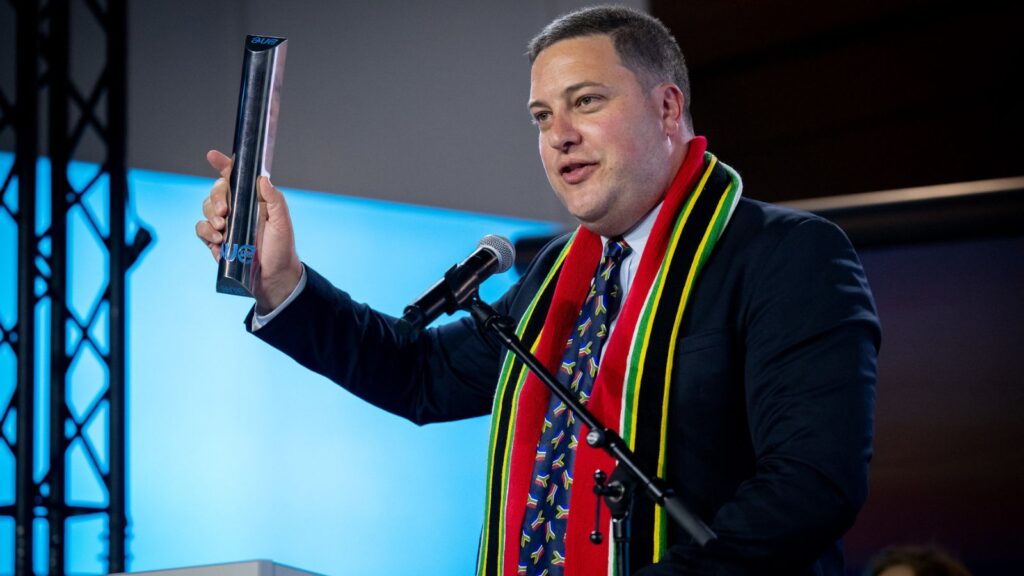
South Africa’s second-biggest political party will assess the performance of its representatives in President Cyril Ramaphosa’s cabinet to determine whether they should retain their posts.
The move was announced by Geordin Hill-Lewis on Monday, a day after he was elected as leader of the Democratic Alliance.
The party joined the so-called government of national unity in 2024 after the African National Congress lost its parliamentary majority for the first time since apartheid ended three decades earlier, taking up six seats in the cabinet and six deputy ministerial posts.
“No one is entitled to any office or position,” Hill-Lewis told reporters at Bloomberg’s Johannesburg offices.
“That should never be the case; that anyone in the DA feels entitled to that, it must be earned through performance.”
While the president has the prerogative to appoint his executive, Ramaphosa has accepted most nominees made by the nine other leaders of parties that are part of his government.
Hill-Lewis, who is due to meet Ramaphosa on Tuesday, said he hadn’t decided whether anyone should be replaced.
He acknowledged that the DA, which has historically had a predominantly White leadership, has work to do to win over a predominantly Black electorate and realise its ambitions of becoming the country’s biggest party in 2029.
The DA won 22% support in the last national vote in 2024, and Ramaphosa’s ANC 40%.
“I’m never, ever going to engage in voter blaming,” Hill-Lewis said. “You can’t blame the voters for not agreeing with your message, or not supporting what you’re offering.”
“You have to look internally, and you have to look at why that trust-deficit gap still exists. And we must do that.”
Hill-Lewis, 39, also serves as the mayor of Cape Town — a post he intends retaining.
His first big test will come in municipal elections that are expected to take place later this year and will gauge whether the DA is managing to capitalise on public anger over a collapse of basic services in ANC-run municipalities.
“The old, very stuck racial silos of our politics are starting to break down,” he said in an earlier interview with Bloomberg TV.
“A growing majority of South Africans are just sick and tired of seeing every basic service, every state function, every state department eroded and dilapidated through corruption and mismanagement. And so the tide really is turning.”
Ramaphosa is expected to step down as ANC leader in 2027 and as the country’s president in 2029.
His deputy, Paul Mashatile, and ANC Secretary-General Fikile Mbalula are considered among the frontrunners to replace him.
Hill-Lewis, who said he has ambitions of becoming president, expects the ANC succession race to test the stability of the coalition government.
The vote within the ANC “is a moment of profound risk,” he said.
“The fights will be incredibly bitter, and we will have to reassess what it means for the coalition government and for the country thereafter.”
