


Data from the Central Energy fund for the end of the second full week of April shows a positive trend for fuel price recoveries, but nowhere near enough to save motorists from another massive hike.
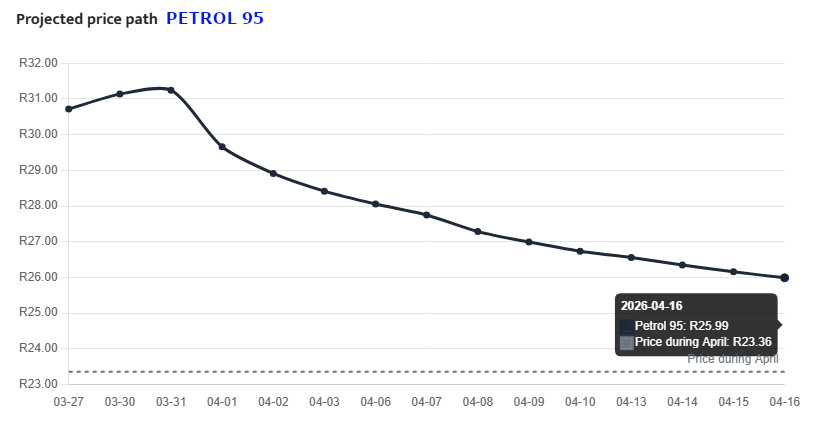
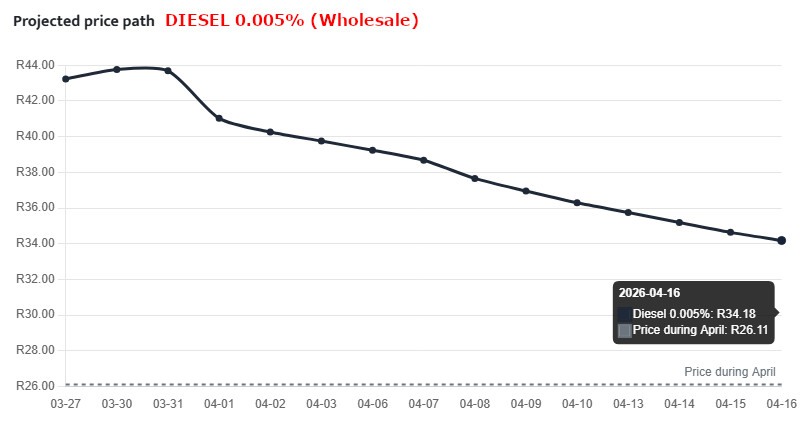
According to the CEF’s latest snapshot, under-recoveries for petrol and diesel have trended lower over the past two weeks.
After starting the review period with an under-recovery of R7.88 per litre for petrol 95 and R17.57 for diesel (0.005% sulphur), these values have more than halved since.
Petrol is showing an under-recovery of between R2.29 and R2.63 per litre, down 67% from the start of the month.
Meanwhile, diesel has pulled back to an under-recovery of around R8.05 per litre, down 54% over the same period.
These are the projected levels at the end of week 2:
- Petrol 93: increase of R2.29 per litre
- Petrol 95: increase of R2.63 per litre
- Diesel 0.05% (wholesale): increase of R8.06 per litre
- Diesel 0.005% (wholesale): increase of R8.07 per litre
- Illuminating paraffin: increase of R6.52 per litre
The CEF does not provide daily snapshot data for LP Gas, so it is not currently possible to provide an expected price for the coming month.
While the data shows a significant swing from the start of the month, market volatility around the war in the Middle East remains a major determining factor.
The CEF data shows that the price of international petroleum products (driven by oil prices) is the biggest contributor to the under-recovery, accounting for over 95% of the shortfall.
This means that the forward path for recoveries hinges on the oil market.
According to Investec Chief Economist, Annabel Bishop, energy price drops are also being limited by uncertainty, as markets are not yet sure the ceasefire in the Middle East will hold.
Meanwhile, infrastructure has been damaged, supply routes are still impeded, allowing fuel prices to only inch down slowly—contrasting the near-immediate surge seen at the start of the war.
Bishop said that the final under-recoveries will be crucial for the fuel price change on 6 May, with another two weeks to go.
During this time, news is also expected from the government on its interventions, with economists keeping a close eye on developments with the National Treasury’s direct fuel relief.
Diesel (0.005%) wholesale daily projections (for May 2026)
Room for more relief in May and June
South Africa has enough fiscal space to extend a fuel-tax cut by two months to cushion consumers from the oil shock triggered by the Iran war, Citigroup Inc. said.
The relief would likely cost the government between R10 billion and R12 billion, Gina Schoeman, the bank’s country economist, said in Johannesburg on Thursday.
“We can see a staggered reduction of the fuel price levy for at least another month, if not another two,” Schoeman said.
“That is certainly feasible in terms of fiscal space,” she said, citing prudent spending, an expected revenue windfall from mining taxes, and the National Treasury’s ability to tap contingency reserves.
South Africa’s Finance Minister Enoch Godongwana joined counterparts from other oil-importing nations from Zambia to Kenya in offering relief to consumers after crude prices surged following the near closure of the Strait of Hormuz amid the US-Israel war with Iran.
He cut the fuel levy by R3.00 per litre for both petrol and diesel this month. Oil prices have risen by almost a third since the conflict began on 28 February.
The Treasury said it would forgo R6 billion in revenue because of the measure, offsetting the shortfall within the fiscal framework approved in the 2026 budget.
It is also working on a broader package of measures to support households.
The oil price surge is likely to push up inflation. Consumer prices rose 3% in February, in line with the central bank’s target, and are expected to peak at 4.3% in April.
Central bank Governor Lesetja Kganyago on Wednesday said policymakers should respond to the inflation shock from the Iran war by ensuring it remains temporary rather than entrenched.
With Bloomberg
