

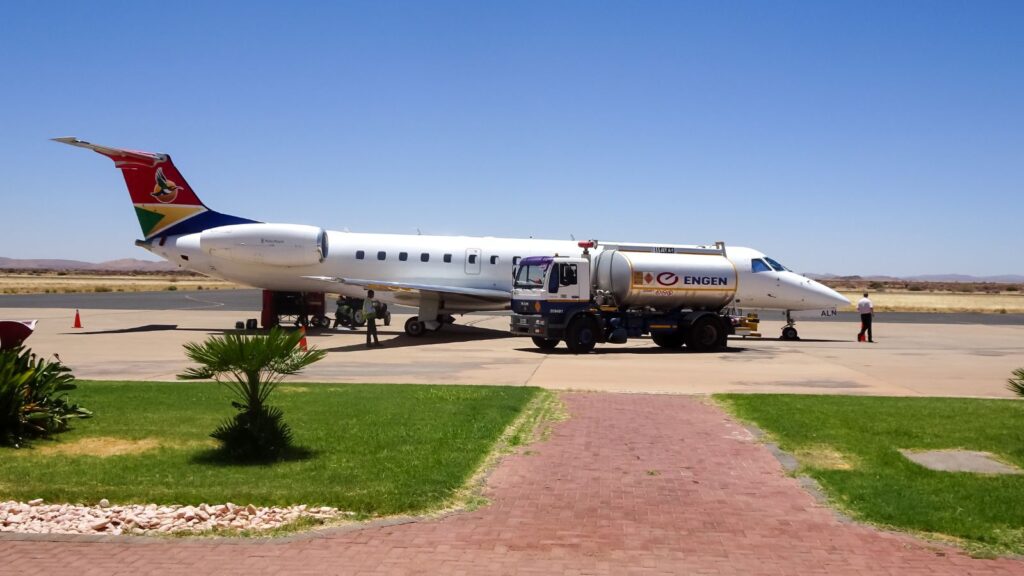
Alarm bells are ringing over the uncertainty of jet fuel availability beyond May 2026. Industry leaders are warning of serious consequences for airlines, passengers, and regional economies if fuel supplies fall.
Airlines Association of Southern Africa (AASA) CEO Aaron Munetsi has raised concerns about the lack of clarity around jet fuel supplies across the Southern African Development Community (SADC) region, which includes South Africa.
In a statement on 24 April, Munetsi urged governments and fuel providers to intervene and provide transparency.
Munetsi said airlines are facing a critical planning challenge, as the industry depends almost entirely on imported crude oil and refined Jet-A1 fuel.
“Airlines require certainty on the security of jet fuel supplies beyond a six-week horizon if they are to maintain their schedules and fulfil their obligations to customers,” he said.
The concerns over jet fuel supplies come amid the prolonged conflict in the Middle East and the blockages of the Straits of Hormuz.
While there is hope that shipping routes will normalise, Munetsi warned that recovery will not be immediate.
“Even when the Straits of Hormuz blockades are lifted, it will take months at the very least for fuel production to return to its previous output,” he said.
Munetsi said the AASA is calling on fuel suppliers, depot operators, airports, and SADC governments to “urgently share their contingency fuel allocation and distribution plans with the aviation industry.”
He stressed that without this visibility, airlines are effectively operating in the dark, and the financial strain on the sector is already severe.
Since the onset of the US-Israel-Iran conflict, Munetsi explained that jet fuel prices in Southern Africa have surged dramatically.
Prices have risen from around R8.50 per litre in mid-February to more than R30.00 per litre by mid-April, with landlocked countries such as Malawi seeing costs exceed R50.00 per litre.
Airlines under pressure

These increases are driven by both higher crude oil prices and fears over supply security. Munetsi highlighted that African airlines were already at a disadvantage.
This is because, before the current crisis, they were already paying among the highest jet fuel prices globally.
“Jet fuel accounted for up to 40% of some of our region’s carriers’ costs,” he said, adding that the latest spike has only deepened the pressure.
In response, many airlines have introduced fuel surcharges to recover costs, while others have begun reducing flight frequencies or consolidating routes.
However, these measures come with consequences. “Airlines are painfully aware of the pressure that increased ticket prices exert on their customers,” Munetsi said.
He said air transport plays a vital role in the region, not only for passenger travel but also for the movement of goods, including pharmaceuticals, perishables, e-commerce shipments, and high-value cargo.
Disruptions in aviation can therefore have far-reaching impacts across multiple sectors. Despite the mounting challenges, Munetsi stressed that airlines cannot be expected to shoulder the costs alone.
He called for greater collaboration across the aviation ecosystem, including airports and air navigation service providers.
“Now, more than at any other time, they have a responsibility to ensure they operate with maximum efficiency,” he said. He urged providers to make efforts to eliminate congestion and delays that waste fuel and drive up costs.
