


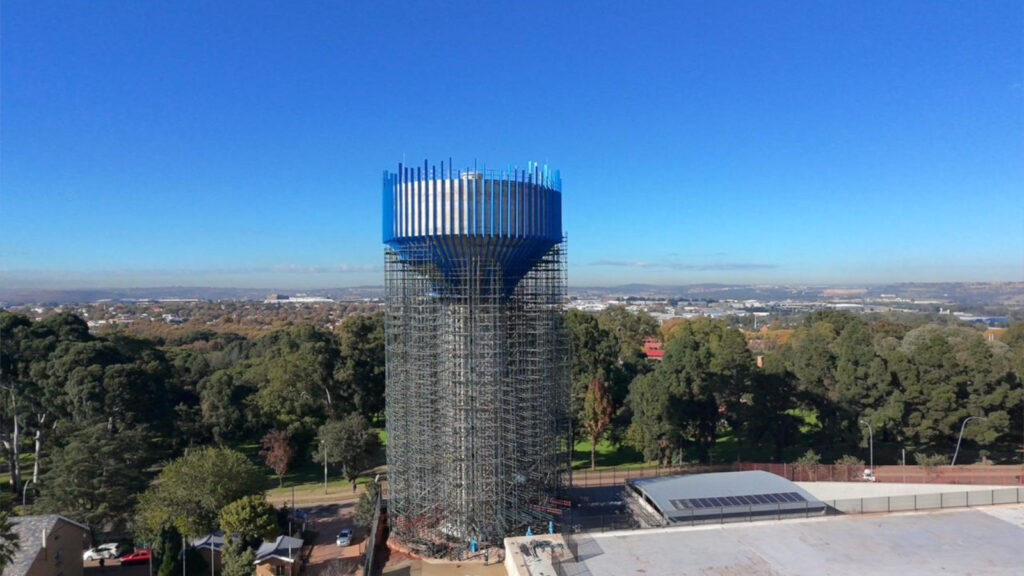
The City of Johannesburg and Joburg Water have officially opened the delayed Brixton Tower and Reservoir as part of a R300 million infrastructure upgrade project in the city.
The Brixton project includes a 26 megalitre reservoir, a 2 megalitre elevated water tower, and a high-capacity pump station.
The city said this will significantly increase water storage capacity and ensure a more consistent, reliable supply across Johannesburg. While this will not resolve the metro’s water crisis, it will go a long way in stabilising supply.
The broader project also includes the revamping of the Crosby pump station, which is still underway. The Crosby pump station will be upgraded to deliver at least 400 litres per second.
Construction of the new Brixton reservoir and tower began in July 2023 and was envisioned as an 18-month project, completed in early 2025.
However, the project was hit with delays, reportedly due to funds allocated to the development being diverted.
Amid a widespread water system failure at the beginning of 2026, the City’s executive and Gauteng Provincial leadership promised to have the tower up and running by the end of February, and then in the first weeks of March.
Now, more than a month later, the system is finally officially open.
In addition to delays, the project’s cost has ballooned. Initially expected to cost R220 million, the projected cost increased to over R280 million by 2025 and reached over R300 million upon launch.
The new and upgraded water infrastructure will boost the Commando System, which, according to Joburg Water, is always the hardest hit by water shortages.
This is because of the City of Johannesburg’s growing population, ageing infrastructure, and various other factors, it said.
The Commando System supplies water to parts of Region B (including Northcliff, Melville, Auckland Park, etc.) and Region F (including the Johannesburg CBD, City Deep, Robertsham, Linmeyer, Fordsburg, etc.).
The system also supplies the universities of Johannesburg and the Witwatersrand, with critical institutions like the Helen Joseph and Rahima Moosa hospitals, which are affected by shortages.
The system’s existing infrastructure was constructed in 1917 and has exceeded its useful lifespan.
Joburg needs to do more
According to Minister of Water and Sanitation, Pemmy Majodina, current and future projects, such as the Brixton development, will help ensure that Joburg has a secure and reliable water supply.
However, responding to parliamentary questions earlier in the month, she warned that more needs to be done to resolve not only the city’s water crisis, but the wider problems in Gauteng.
Specifically, she flagged excessive water demand as a critical factor, noting that the province’s water supplier, Rand Water, is tied up.
“The population of Gauteng, and the demand for water, has risen exponentially,” she said. “The demand for water is sometimes exceeding the available supply from Rand Water.”
She noted that Rand Water could easily supply sufficient water to Gauteng municipalities if demand—including leaks in municipal distribution systems—could be brought down.
“Municipalities in Gauteng have neglected investment in their infrastructure for decades, making their systems vulnerable to disruptions,” she said.
“When unusual events such as heat waves, heavy load shedding or electro-mechanical breakdowns occur, then the municipalities’ limited storage reservoirs are unable to meet peak demand.”
The minister said the second phase of the Lesotho Highlands Water Project will provide more raw water into the Integrated Vaal River System by 2028, and Rand Water will be able to treat more water.
However, she stressed that Rand Water is already operating under a temporary increase in abstraction license from the department.
“So the additional water from the Lesotho Highlands Water Project will not negate the need to reduce demand in Gauteng.”
The minister said that Gauteng municipalities, including the City of Joburg, need to do more to address this, including implementing and enforcing stronger water use restrictions.
She added that they should reduce water losses through leak repair and pressure reduction, and invest in additional storage and pumping capacity, such as the Brixton Tower and Reservoir.
Finally, she said that they should enter into public-private partnerships for the re-use of effluent from wastewater treatment works and the replacement of ageing, leaking pipes.
