


Residents of the popular St Francis Bay are concerned about the prospect of becoming a nuclear town amid plans to build a nuclear power station in the area.
Eskom has steadily proceeded with its plan to build a new nuclear power station in South Africa.
MyBroadband reported that engineering consulting firm WSP released a Draft Environmental Scoping Report in April to determine the potential environmental impacts of the station’s construction.
The report points to Thyspunt in the Eastern Cape’s Kouga Local Municipality as an ideal location in the country for the construction of a nuclear power plant.
WSP also noted that its proximity to existing grid infrastructure makes it a better choice than the second-choice location, Bantamsklip in the Western Cape’s Overberg region.
“This reduces the need for extensive new linear infrastructure and limits land acquisition and servitude requirements,” WSP explained.
“It also lowers the potential for additional environmental and social impacts associated with grid connection and access development.”
However, speaking in an interview with BizNews, resident Trudi Malan and leader of the Thyspunt Alliance explained that opposition to nuclear development in the area stretches back decades.
She added that Eskom’s public consultation process has been inadequate and that concerns raised by residents have largely been ignored, noting that the plan will likely end up in the courts if it goes ahead.
“We’ve been involved in this, submitting comments and responding to the environmental impact assessment since I can remember living here, which is nearly 25 years,” she said.
The Thyspunt site, situated between Oyster Bay, St Francis Bay and Humansdorp, has long been identified by Eskom as a preferred nuclear location.
However, Malan argued the site was selected during the apartheid government’s time, and that environmental and heritage protections were far weaker when the sites were first chosen.
She highlighted that the site was selected in the 1980s and noted that Eskom has been acquiring land there ever since.
Plan will end up in the courts
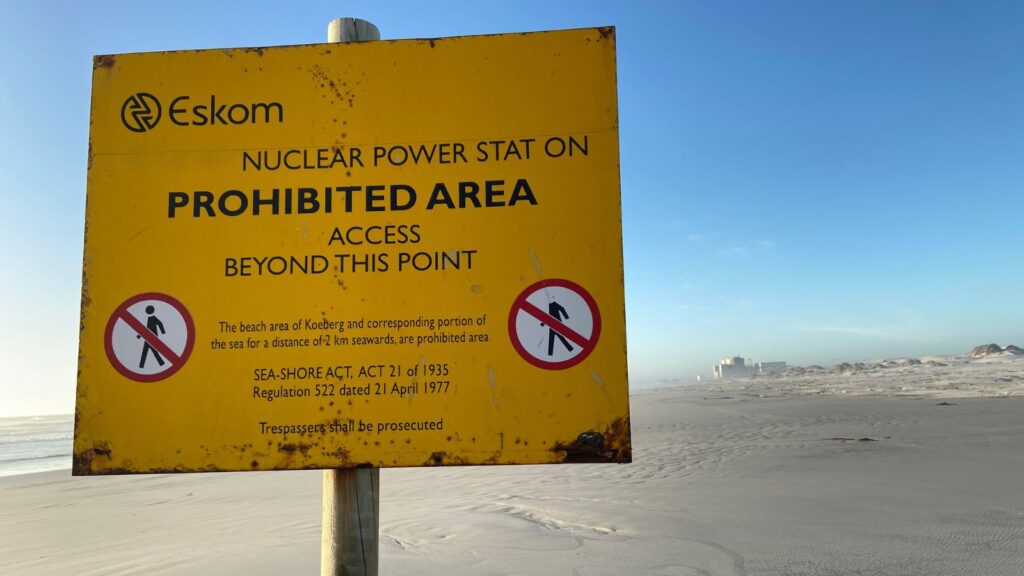
She believes the renewed focus on Thyspunt ignores the area’s significance. “From a biodiversity perspective, [it is a] very important site with systems that can have downstream impacts on communities and water security.”
Despite concerns about limited consultation, Malan said residents have shown strong engagement and opposition.
“Our community is very strong. The community has turned up for the meetings to give their inputs with very good questions that could not be answered,” she said.
Safety concerns remain a major sticking point, particularly around evacuation. “There’s only one road leading out of the town,” she said, and added that multiple communities would have to use the same route.
“If something goes wrong, I’m not getting out,” she said. Malan noted that this has been brought up wth Eskom and there was a lack of clear emergency planning.
Malan also believes the process is fundamentally flawed. “At the moment, we don’t think it’s a fair process. It does not address half of the issues of the current scoping phase,” she said.
As a result, she expects the battle over Thyspunt to escalate beyond public participation. “There’s always that question of whether the government persevere, or will the people stand up and then we go to lawfare. We’re going to use the courts in the end,” she said.
Malan said that the outcome increasingly appears inevitable as they prepare detailed submissions challenging the project.
While Eskom chief nuclear officer Velaphi Ntuli expected to secure environmental authorisation for the project by late 2027, some have criticised the plan to go nuclear.
Virtual Energy and Power director and energy expert Clyde Mallinson has said that including nuclear as an important energy source is unnecessary and potentially extremely costly.
“By 2040, when the nuclear may or may not be built, we will have 90GW of solar, 60GW of wind, and 50GW of storage,” he said.
Mallinson added that nuclear power would be ranked as the most expensive and inflexible form of generation compared to wind and solar power.
