

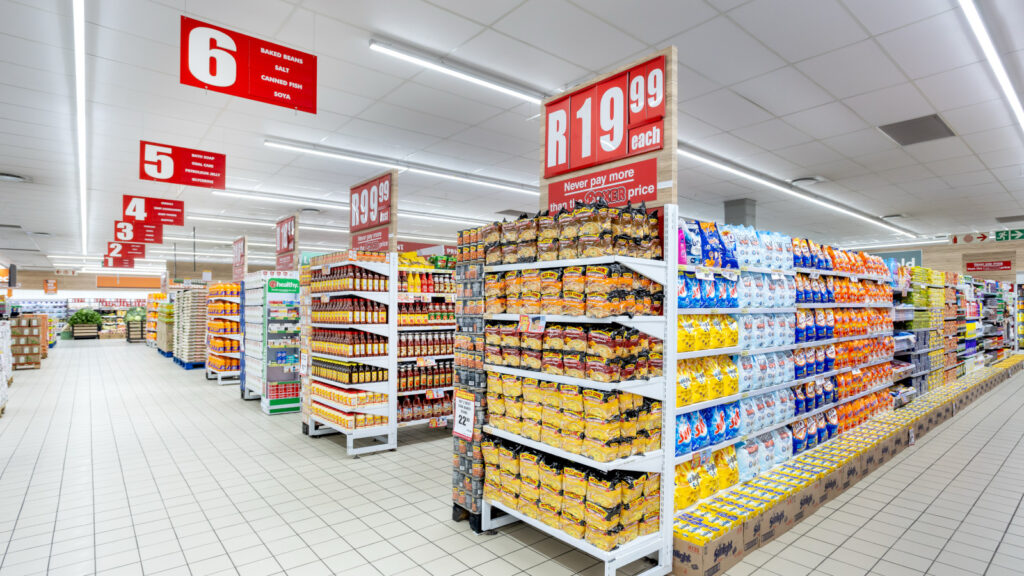
Boxer is massively expanding its store base across South Africa, with the retailer looking to expand its discount offerings.
In its recent financial results for the year ended 1 March, grocery retailer Boxer said that it added 51 net new stores in 2026, bringing its nationwide store count to 576.
The group added 18 new superstores, 31 liquor stores, and 2 new build stores. Liquor stores as a percentage of Superstores rose from 55% to 61%.
According to its financial results, Boxer’s new stores contributed 7.8% total turnover growth, excluding like-for-like sales.
Boxer has quickly become one of the most valuable retailers in South Africa. The group has a market cap of R36.6 billion, which is far above Pick n Pay’s R14.2 billion.
Incidentally, much of Pick n Pay’s own value is tied to Boxer.
The group is also worth more than several other major convenience retailers in South Africa, based on market cap, including SPAR (R12.1 billion) and Dis-Chem (R30.9 billion).
“The Boxer team has delivered an exceptional FY26 performance, underscoring the strength, resilience and continued evolution of our discount operating model,” said Boxer CEO Marek Masojada.
“[The team] remains firmly committed to delivering unmatched value and everyday affordability to the communities we serve.”
The group said that it continued to gain market share despite the challenging macroeconomic environment. It increased turnover by 12.3% on a comparable 52-week basis to R46.7 billion.
The group’s reported financial results include a 53-week base for FY25, meaning that on a reported basis, the group’s turnover rose by 9.6%.
The group said it continued to invest in prices to deliver value to customers, with internal selling price inflation, measured on a volume-held-constant basis, reported at -1.2% for FY26.
The group said that deflation deepened in the second half of this year from -0.7% in H1 to -1.6% in H2.
The group said that its gross profit margin for the period expanded by 0.3% to 21.6% from a restated 21.3% in FY25.
“This margin expansion was driven by exceptional margin mix management and economies of scale, which more than offset the continued investment in lower prices for customers throughout the period,” it said.
“Despite the improvement, Boxer’s gross margin remains below that of listed food retail peers, which is testament to the great value Boxer delivers to its customers every day.”
| Category | FY26 | FY25 | Net Additions | % Growth |
| Total stores | 576 | 525 | 51 | 9.7% |
| Superstores | 338 | 320 | 18 | 5.6% |
| Liquor | 206 | 175 | 31 | 17.7% |
| Build | 32 | 30 | 2 | 6.7% |
| Liquor stores as % of Superstores | 61% | 55% | – | – |
| Trading space (GLA, sqm) | 694.4 | 649.8 | – | 6.9% |
Accounting differences
Trading expenses increased by 10.9%, including the additional week in the prior-year base, primarily driven by the group’s accelerated new store rollout, with trading space increasing by 6.9% during the year.
The group said that trading expenses as a percentage of turnover increased to 16.8% from 16.6% in FY25, reflecting incremental costs associated with operating as a listed entity following its 2024 IPO.
With Boxer now entering FY27, these IPO-related expenses are now fully absorbed into the base.
The group’s trading profit grew by 14.3% to R2.6 billion, with the trading profit margin expanding to 5.7% from 5.4% in FY25.
The group’s headline earnings for the period rose by 13.2% to R1.60 billion in FY26. However, the group’s headline earnings per share (HEPS) declined to 351.67 cents.
The group said that the decline in earnings per share (EPS) and HEPS is due to the IPO structure, which led to a substantial increase in the number of issued shares during November 2024.
The group’s board declared a final dividend of 95.37 cents per share, which brought the total FY26 dividend to 140.67 cents per share. The group’s payout ratio stood at 40%.
“We will continue to execute a range of innovation initiatives focused on improving efficiency, deepening supplier collaboration, and enhancing customer convenience,” said Masojada.
“This will further strengthen our ability to adapt to changing customer needs, scale efficiently and reinforce our long-term competitive advantage, while remaining firmly focused on delivering low prices.”
The CEO admitted that elevated oil and diesel prices are creating uncertainty around the FY27 trading environment, especially in relation to food inflation, logistics costs and consumer spending.
Nevertheless, he said that the group remains confident in the resilience of its discount model and long-term growth strategy.
“The group has a strong track record of navigating challenging trading conditions and will remain focused on disciplined execution, affordability and expanding access to value for customers,” he said.
| Financials | FY26 (52 weeks) 01 March 2026 | FY25 (53 weeks) 02 March 2025 | % Change |
| Turnover | R46.7 billion | R42.6 billion* | 9.6% |
| Trading profit | R2.64 billion | R2.31 billion | 14.3% |
| Trading profit margin | 5.7 % | 5.4% | |
| Profit before tax before capital items | R2.16 billion | R1.94 billion | 11.1% |
| Headline earnings | R1.60 billion | R1.41 billion | 13.2% |
| Headline earnings per share (HEPS) – cents | 351.67 | 413.76 | (15.0%) |
| Dividend per share – cents | 140.67 | ||
| Pro forma FY25 (52 weeks) | |||
| Turnover (52/52w) | R46.7 billion | R41.6 billion | 12.3% |
| Trading profit (52/52w) | R2.64 billion | R2.25 billion | 17.3% |
| Trading profit margin | 5.7 % | 5.4% |
