
South Africa’s latest Quarterly Labour Force Survey (QLFS) shows that the North West and the Eastern Cape are the only two provinces where more people are unemployed than working, and the situation has deteriorated.
According to the latest Quarterly Labour Force Survey (QLFS) from Stats SA, the number of employed persons decreased by 345,000 in the first quarter of the year, bringing the total to 16.8 million.
The number of unemployed people increased by 301,000. This resulted in a net decrease of 44,000 (0.2%) in the country’s labour force.
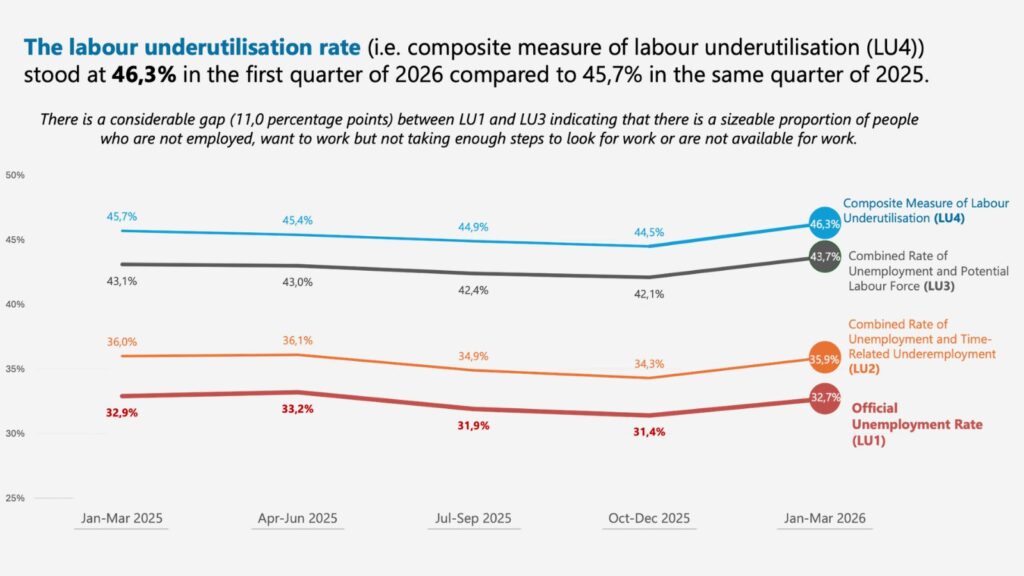
Because of this, the official unemployment rate increased by 1.3 percentage points to 32.7% for the quarter, up from 31.4% in the fourth quarter of 2025.
According to the latest report, discouraged job-seekers increased by 178,000 to 3.9 million. Other available job-seekers increased by 55,000 to 910,000, and unavailable job-seekers increased by 6,000 to 49,000.
Those outside the labour force for other reasons decreased by 75,000 to 12.4 million. In addition to the unemployment rate, other measures of labour underutilisation were also used.
The combined rate of unemployment and time-related underemployment increased by 1.6 percentage points to 35.9%.
Additionally, the combined rate of unemployment and potential labour force (formerly tracked as the expanded unemployment rate) increased by 1.6 percentage points to 43.7% in the first quarter.
The composite measure of labour underutilisation, which combines time-related underemployment, unemployment and potential labour force as a proportion of the extended labour force, was 46.3%.
Stats SA noted that these labour underutilisation measures highlight people in different situations and with different degrees of attachment to the labour market. Employed persons decreased in seven of the ten industries.
The largest decreases in employment were recorded in the Community and social services industry (206,000), followed by Construction (110,000), Transport (30,000) and Private households (28,000).
Employment increased in Manufacturing (38,000), followed by Mining (32,000) and Agriculture (10,000).
Two provinces are in deep trouble
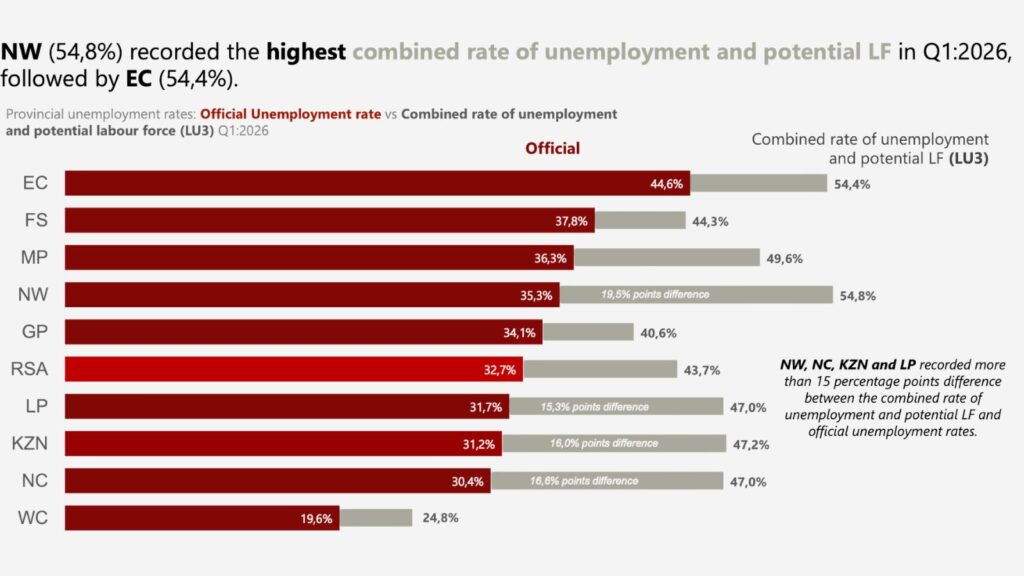
Across the provinces, the differences are notable. The Western Cape continues to have the lowest official unemployment rate in the country at 19.6%, which remains the best-performing province for over a decade.
The Northern Cape follows at 30.4%, while KwaZulu-Natal recorded rates of 31.2% and Limpopo recorded 31.7%.
However, the situation looks much worse in the North West and the Eastern Cape. The Eastern Cape recorded the largest increase in unemployment of the two provinces.
The Eastern Cape saw a 2.1 percentage-point change from the fourth quarter of 2025 to the first quarter of 2026, while the North West noted a 0.2% increase.
However, under the new expanded definition, the North West saw a massive 19.5 percentage-point difference between the combined rate of unemployment and potential LF and official unemployment rates.
The North West recorded an expanded unemployment rate of 54.8%, which is a 3.9 percentage-point change from the 50.9% at the end of 2025.
This means the North West has overtaken the Eastern Cape as having the most people unemployed than working in South Africa, despite the situation also worsening there as well.
The Eastern Cape recorded an expanded unemployment rate of 54.4%, a three percentage-point change from the 51.4% at the end of 2025.
By contrast, the Western Cape’s expanded unemployment rate is recorded at 24.8%, showing that its economy remains relatively stable and better able to create jobs.
Still, the national picture shows that South Africa’s job market remains deeply uneven.
Mpumalanga also faces major challenges, with an expanded unemployment rate of 49.6%, placing it just behind the North West and Eastern Cape.