

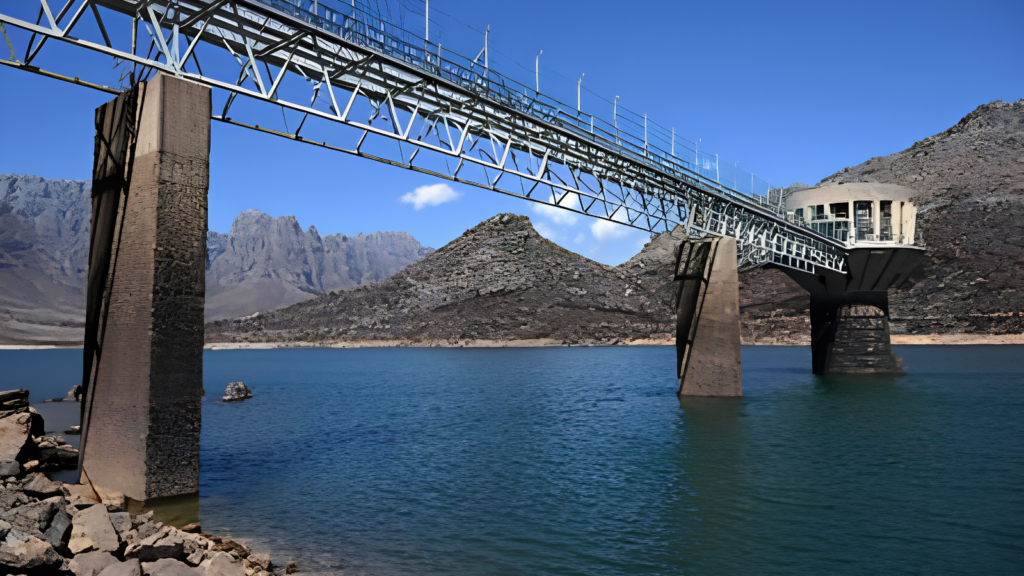
Cape Town’s dam levels have increased by about 20% in just one week due to a recent and unusual rainfall event, taking the city out of the ‘early drought caution’ stage.
Such extreme rainfall is expected to occur only once every 20 to 200 years in several of the affected catchments.
Currently, Cape Town’s dam levels stand at 70.8%, allowing the city to move out of the ‘early drought caution’ stage.
However, the City of Cape Town is still urging residents to remain water-wise and use water responsibly, regardless of the current dam levels.
Cape Town is supplied by a network of six major dams known collectively as the “Big Six,” which form the core of the Western Cape Water Supply System (WCWSS):
- Theewaterskloof Dam: The largest dam, holding more than half of Cape Town’s total water storage capacity. It is located near Villiersdorp.
- Voëlvlei Dam: The second-largest supply dam in the system, located near Gouda.
- Berg River Dam: A significant rock-fill dam located near Franschhoek.
- Wemmershoek Dam: The largest dam directly owned by the City of Cape Town, also located near Franschhoek.
- Steenbras Lower Dam: Situated in the Hottentots-Holland mountains above Gordon’s Bay.
- Steenbras Upper Dam: Located directly upstream from the Lower Dam, it is used for a hydroelectric pumped-storage scheme.
The current dam levels represent an increase of 19.9% compared to the previous week and is 11.6% higher than the same time last year, when levels were at 59.2%.
Water usage has risen to 871 million litres per day (MLD), up from 831 MLD last week. This is 11 MLD above the winter usage target of 860 MLD.
“Even though this extraordinary rainfall event has been key to filling our dams by almost 20% in a week, we still need to be water-wise,” said Mayoral Committee Member for Water and Sanitation Councillor Zahid Badroodien.
“We don’t know when we will get rain again, and if it comes, how much we will get and if it is going to fall in the right place, in the catchment areas of dams, so dam levels can increase,” he said.
Badroodien said that an event like this does not guarantee above-average rainfall for the rest of the year.
Historic dams on Table Mountain

Cape Town has five dams on Table Mountain, all built as part of a larger water-supply project for the city, with the first one built in 1890.
The dams on the top of Table Mountain were built to sustain the rapid population growth as its existing water sources were not enough.
The five dams were named after the five men who played a crucial part in their construction: Hely-Hutchinson, De Villiers, Woodhead, Alexandria, and Victoria.
Until the 1880s, Cape Town relied on a single mountain stream to supply water to the entire city.
During a drought, town planners recognised the need for a new water source.
Hydraulic engineers built a tunnel through the Twelve Apostles to capture water from the Disa River, transporting it to the Molteno Reservoir via a duct known as the “pipe track.”
As construction progressed, the city’s water demands increased, revealing that the additional supply would be insufficient.
The dams, made from concrete and stone, could hold 22 million gallons and were filled through pipelines and aqueducts from nearby streams and rivers.
This water was then pumped to the city for distribution to homes and businesses.
The first dam built on Table Mountain is the Woodhead Reservoir. Construction efforts to build the 252-meter-long, 44-meter-high dam wall required porters to transport building materials by hand up the Kasteelpoort Ravine.
Eventually, a small steam-powered cable car was built to assist with this process. From the top of the cable car, materials were transported by locomotive to the dam site, which was located 2 kilometres away.
The upper station of the cable car quickly developed into a small town, complete with a bank, a general store, and a post office.
