

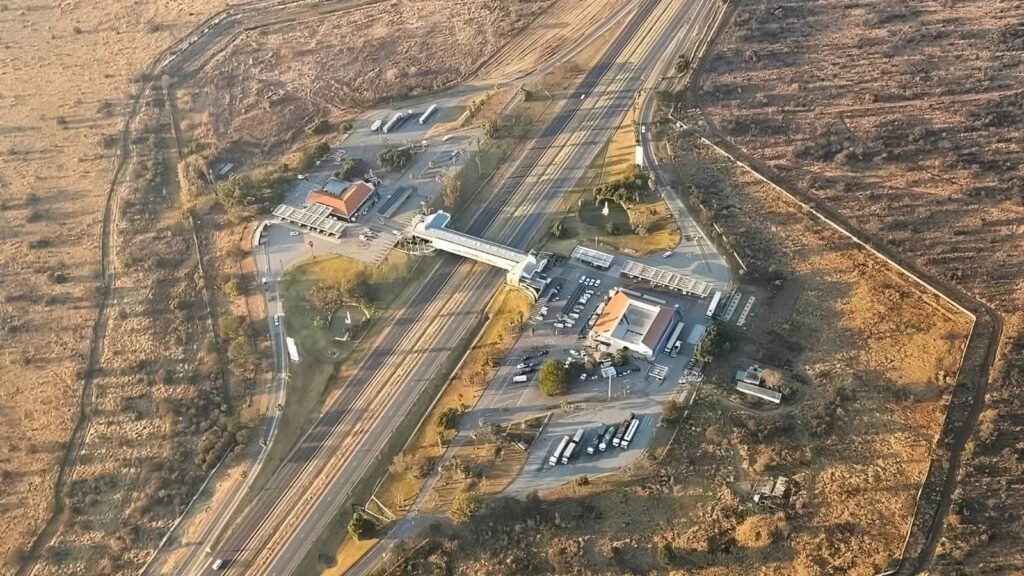
Business group Sakeliga has warned that new draft rules proposed by the South African National Roads Agency (SANRAL) could unlawfully expand the agency’s powers over private businesses.
The policy would also impose broad black economic empowerment (BEE) requirements on privately owned petrol stations and other roadside businesses in South Africa.
These concerns relate to SANRAL’s Draft Policy for Rest and Service Facilities along National Roads.
The policy aims to regulate developments such as petrol stations, truck stops, restaurants, convenience stores, and future infrastructure linked to electric vehicles and alternative fuels.
In a statement objecting to the draft policy, Sakeliga argued that SANRAL is attempting to use its authority over national roads to control businesses operating on private land.
The group argued that the Draft Policy would give SANRAL sweeping power to dictate who may operate a business alongside a national road, what transformation credentials they must hold, how their business must be structured, and what levies they must pay.
This is the case even if the business operates on privately owned land and has no contractual relationship with SANRAL.
According to Sakeliga, SANRAL is relying on sections of the SANRAL Act that were intended to regulate access to national roads for road safety and traffic flow purposes.
However, the group said the agency is now trying to use those provisions to introduce a much broader commercial and socio-economic regulatory system.
“The road agency’s authority, as defined by the SANRAL Act, is restricted to the planning, financing, construction, operation, management, and maintenance of national roads,” Sakeliga said.
“SANRAL is not an economic regulator, a licensing authority for private businesses, or empowered to impose transformation requirements on private landowners.”
A major point of concern is that the draft policy would require roadside businesses to comply with SANRAL’s own Transformation Policy.
Sakeliga argued that this policy was originally designed only for companies contracted by SANRAL for road construction and maintenance work.
“The Draft Policy now requires private businesses on private land to comply with the same framework, even though they are not contracting with SANRAL, are not spending public money, and are not supplying any product or service to SANRAL,” the group said.
Draft policy risks economic consequences
Sakeliga warned that this would effectively create a parallel BEE compliance regime for private businesses by making transformation requirements a condition for access to the national road network.
The organisation also argued that the draft rules could have severe economic consequences for South Africa.
It claimed the policy would increase barriers to entry through centralised approvals and spacing rules, reduce competition by protecting existing operators, and raise costs through turnover-based levies of up to 10%.
It further warned that investment could be discouraged by regulatory uncertainty, discretionary approval processes, and short lease periods.
“Private businesses operating on private land should not be required to surrender ownership, restructure their operations, or demonstrate transformation credentials to a roads agency,” Sakeliga said.
The organisation added that it would challenge the policy if it were adopted in its current form or in any similar form.
Civil rights organisation AfriForum has also raised concerns about the draft policy, warning that its implications could extend far beyond petrol stations and traditional rest stops.
AfriForum said the proposed amendments would allow SANRAL to decide where facilities may be located, what kinds of businesses may operate near national roads, how far apart they must be, and under what conditions access may be approved or changed.
The organisation argued that these functions usually fall under municipalities and environmental authorities, raising questions about whether SANRAL is legally allowed to assume such powers.
AfriForum warned that the policy could negatively affect farmers, tourism operators, accommodation providers, farm stalls, and other rural businesses that depend on access to national roads for economic activity.
The group also raised concerns about a potential conflict of interest, as SANRAL would both regulate developments and participate commercially by leasing its own land for similar facilities.
“The draft policy appears to go beyond SANRAL’s legal mandate and introduces far-reaching control over land use and commercial activity next to national roads,” said Marais de Vaal, AfriForum’s Advisor for Environmental Affairs.
While AfriForum acknowledged the importance of preparing for electric mobility and alternative fuels, it argued that this should not come at the expense of property rights, fair competition, and lawful administrative processes.
The organisation said it plans to submit formal comments on the draft amendments and has requested an extension to the public comment period to allow for a more thorough legal and policy review.
