

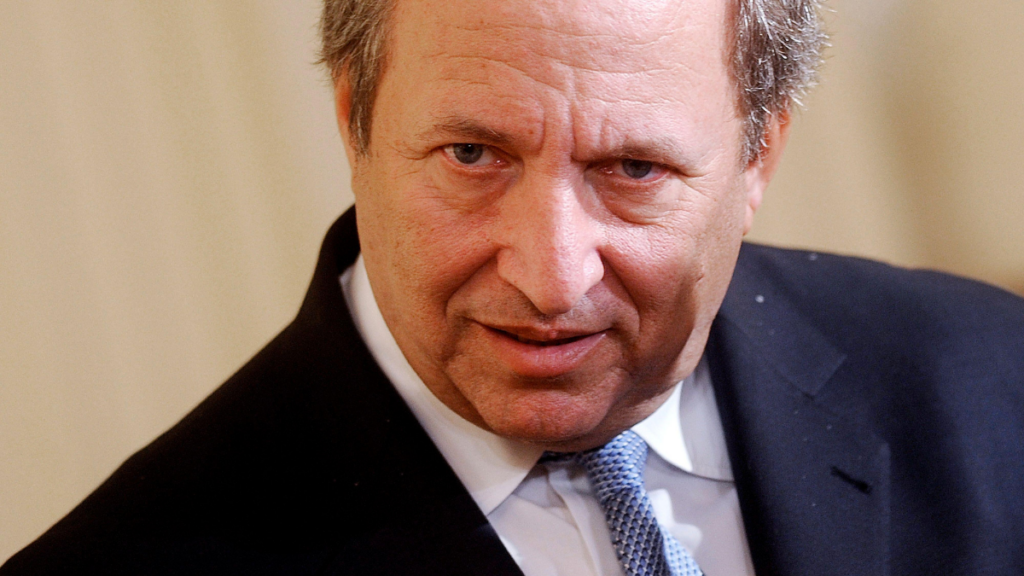
Until last week Monday, I had a sometimes grudging, but deep respect for Larry Summers, as one of the most insightful economists of the modern era. I had previously brushed aside some of his previous failings, in sheer admiration of his ability to see the long-run consequences of relentless central bank money printing during the Covid pandemic. His voice seemed, at that time, to make sense of the enormous systemic shift that had taken place over the past decade and a half, since the Global Financial Crisis.
But, after the US Congress released twenty thousand pages of documents received from Jeffrey Epstein’s estate last week, I felt compelled to look more closely at the correspondence that emerged between Larry Summers and Jeffrey Epstein. Among the pages were a series of emails exchanged between Summers and Epstein in which Summers was seeking advice on pursuing an extramarital relationship with Keyu Jin, daughter of Jin Liqun, a former high-ranking member of the Chinese Communist Party. Summers described her at the time as his mentee.
Excerpts from the emails shared widely by the media read like a tortured teenage diatribe, the famed economist pitifully reduced to a yearning preteen chauvinist by the striking insecurity underlying the comments he makes about Jin. Most damningly, these exchanges occurred during 2018 and 2019, a full decade after Epstein first plead guilty to sex crimes involving a minor in 2008, and just months before he was arrested for sex trafficking of minors in mid-2019.
In a public statement on Monday 17 November, Summers accepted responsibility for his actions, saying, “I am deeply ashamed of my actions and recognise the pain they have caused”. He has also announced that he will be stepping away from many of his public roles, including leaving leadership positions in several think-tanks such as Yale University’s Budget Lab, the Brookings Institution and the Center for American Progress, as well as resigning from the board of OpenAI, “as one part of my broader effort to rebuild trust and repair relationships with the people closest to me.”
Summers has also taken leave from teaching at Harvard University, where he has been a tenured professor since 1983, with Democrat Senator Elizabeth Warren calling for Harvard to dismiss him from his position permanently.
This is not the first time that Summers has been embroiled in a scandal. In 2005, while president of Harvard, he gave a speech in which he suggested that the underrepresentation of women in tenured positions in science and engineering was due to their weaker cognitive abilities – or, as he put it, “different availability of aptitude at the high end”. Facing immediate backlash Summers apologised for the comment, but lost his position as president following a vote of no confidence.
These scandals cast a long shadow over a man who, in his professional and intellectual life, has become one of the most influential voices of our time. Summers became a tenured professor at Harvard while still in his twenties and later received the prestigious John Bates Clark Medal, awarded to leading American economists under the age of forty. In the early 1990s, he served as Chief Economist of the World Bank before moving to the US Treasury, where he became Deputy Secretary in 1993 and Treasury Secretary in 1999.
Over this period, he played a pivotal role in shaping America’s response to the financial crises in Mexico, Asia, and Russia, and in steering the country through the turbulence of the 1990s dot-com boom.
It was during this time, however, that he also gained a reputation for strongly supporting a broad move towards financial deregulation. Summers was a key figure in passing the Gramm-Leach-Bliley Act in 1999, which repealed the Glass-Steagall Act, a Depression-era piece of legislation that had separated commercial and investment banking activities in America for over sixty years. He was also central in driving the Commodity Futures Modernization Act, passed in 2000, which effectively deregulated the over-the-counter (OTC) derivatives market.
This proved a climactic moment in a fiercely fought battle that had been waged during the decade prior, when Summers, together with Fed Chair Alan Greenspan, chairman of the Securities and Exchange Commission Arthur Levitt, and Treasury Secretary Robert Rubin, had worked to suppress attempts made by the chair of the Commodity Futures Trading Commission at the time, Brooksley Born, to increase regulatory oversight of OTC derivatives.
The risks inherent in maintaining a highly opaque OTC derivatives market would quickly become clear. In the days before the 9/11 terrorist attacks in the US in 2001, trading in derivatives on both United Airlines and American Airlines stock was unusually erratic, with the put-to-call ratio for American Airlines reaching 6:1 and for United Airlines reaching 25:1. Ordinarily, this ratio should be about 1:1, prompting widespread speculation that some investors may have acted on advance knowledge.
Summers’ push for deregulation would also ultimately contribute to the largely unchecked expansion of investment-banking activities in the lead up to the 2007/2008 Global Financial Crisis. In some respects, it can authentically be argued that his policies enabled the Crisis.
Summers nonetheless remained a regular commentator on respected media platforms such as The Financial Times, CNN and The New York Times, and continued to teach at Harvard.
The contradiction inherent in the figure of Larry Summers – that is to say, on the one hand a soothsayer of our modern era, versus, on the other, an entitled predator – exposes ever more clearly what we used to call mass cognitive dissonance. The notion that one can hold two completely contradictory systems of belief in one’s head, at the same time. Then, after a while, we started calling it the great moral blind spot in the scope of the Western conscience.
Now, reading the stomach-churning interchange between Larry Summers and Jeffrey Epstein – just a few months before the latter’s arrest and “suicide” – it occurred to me that this is no longer a question of moral vision. This is a time of absurdity and nihilism. This was what Albert Camus must have envisioned in the midst of World War II, that the only way to understand and deal with the world around oneself, is to view the whole thing as absurd.
From meme coins, to fascist Nazi-style immigration officers, to global economic warfare played out as if it were a children’s board game, to cowing to autocratic murderers in the White House, to demanding a Nobel Peace Prize – this has now gone way beyond comical.
Let us not forget, however, on the other side of the fence, the pardoning of one’s own son, nor the harbouring of a senile leader at the helm of the most powerful nation on earth, nor the false piety and self-righteousness of the left. It is then – in this context – not so surprising at all, that one of the most important economists of our time would be cut down by the most base of all human characteristics – by what can only be described as a sort of preteen egotistical infatuation, manifesting an outright unholy intent.
This is not cognitive dissonance, nor moral blindness. This is an abuse of power, at its most base. What it says about Larry Summers is very sad. What it says about where we find ourselves in the world right now, is diabolical.
This article is an opinion piece by David Buckham. The views in this article are those of Buckham, and do not represent the views of BusinessTech and its associated companies.
David Buckham is the Founder and CEO of international consultancy Monocle Solutions. He is co-author, alongside Robin Wilkinson, of the recently released The Spell: A Story of Human Progress and How the West Lost its Soul.
