

Discovery CEO Adrian Gore said that leaders should recognise that a small group of highly productive individuals can make a significant difference.
Conversely, a small group of people can also negatively impact a system and cause significant damage in the process.
Gore shared his thoughts about the issue in the March 2022 issue of The Steel and Engineering Industries Federation of Southern Africa (SEIFSA) magazine.
In the article titled, We Need to Let Go of the Bell Curve, Gore highlighted the impact of the Pareto distribution, also known as the “80-20 rule”.
He described how 21% of Discovery Bank’s new cardholders account for 80% of spending. This worried one of the senior managers greatly.
“He wondered what we could do to spread our lending book more evenly,” Gore said in his article.
“I’ve had similar conversations with the fundraising manager of a non-profit I chair. The bulk of the funding comes from 20 donors, which she said is unsustainable.”
She was concerned that the organisation was heading toward a cliff because such a small group makes up most of the revenue.
Gore warned that both of these reactions reveal a common cognitive error that has profound implications for leadership.
The foundation of this cognitive error is that most people believe human activities follow a normal distribution, also known as a Gaussian curve.
For most physical attributes, this is the case, with a more frequent occurrence near the mean than far away from the mean.
Most people will have IQ scores around the mean of 100, with very few individuals recording scores that are significantly far away from the mean.
The average height of an American male is 5’9″, and 50% of the population has a height within 2 inches of this mean. However, only 2% are shorter than 5’1 or taller than 6’4.
However, this is not the case for human activities. It follows a Pareto distribution instead of a Gaussian curve.
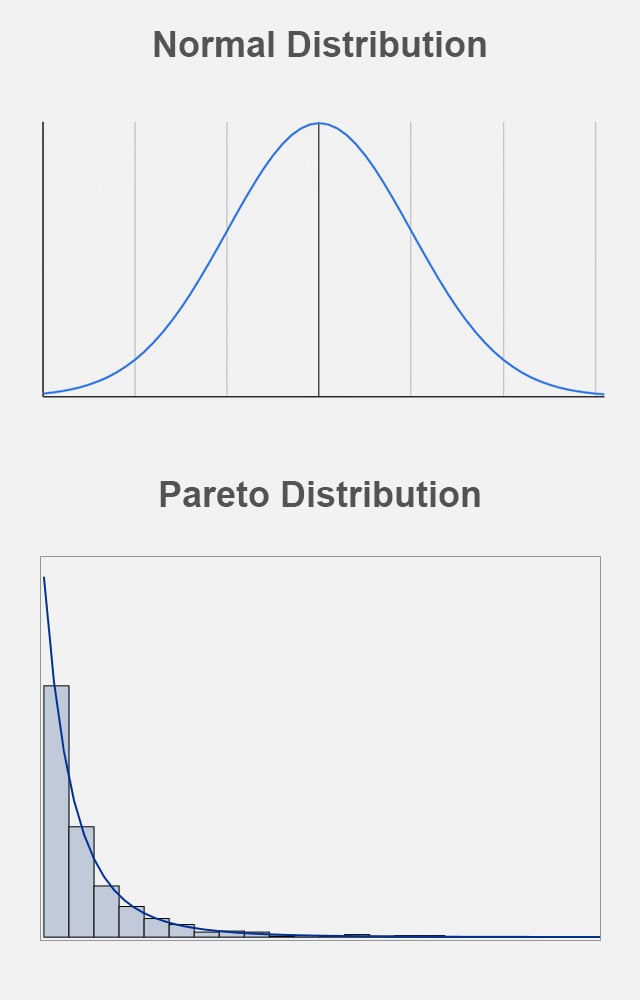
Pareto distribution and human activity
The Italian economist Vilfredo Pareto observed that 80% of the country’s wealth was concentrated in the hands of only 20% of the population.
He developed a power-law probability distribution to describe systems where a small number of events account for a large proportion of the total outcome.
This distribution is observed worldwide in economics, insurance, technology, business, and even in forest fires.
Gore said for many companies, 80% of revenue and profits typically come from 20% of products and services.
In healthcare, the sickest 20% of patients generate 79% of healthcare costs. Within this 20%, the sickest 20% account for 60% of the total costs.
With many human activities following the 80-20 rule, Gore urged leaders to recalibrate their perspective from a normal distribution to a Pareto distribution.
“The realisation that we live in a largely Pareto world—which is inherently unfair, asymmetric, and unpredictable—may feel unpleasant at first,” Gore said.
However, the upside is that making a change will have a much faster and bigger impact than people realise. The practical implications of this perspective are profound.
“In Pareto distributions, a small change in one variable is associated with a large change in another,” Gore said.
“A few key decisions, from whom we marry to what careers we choose, end up having an enormous impact on our future.”
In the business world and the government, the impact can be profound. Hiring exceptional people can transform a system.
Gore advised leaders to recruit and retain the best possible people across the board. “Create an A+ team to leverage A+ players’ impact,” he said.
“Consistently attracting and retaining exceptional talent across the entire organisation will lift the entire talent curve.”
Pareto principle in sport
It can be challenging to track the performance of individuals in a business and accurately quantify their impact on the organisation.
However, it is much easier in sports. The Professional Darts Corporation’s (PDC’s) Order of Merit provides a great example of the Pareto principle.
The PDC Order of Merit is based on prize money won over two years by players in ranking tournaments.
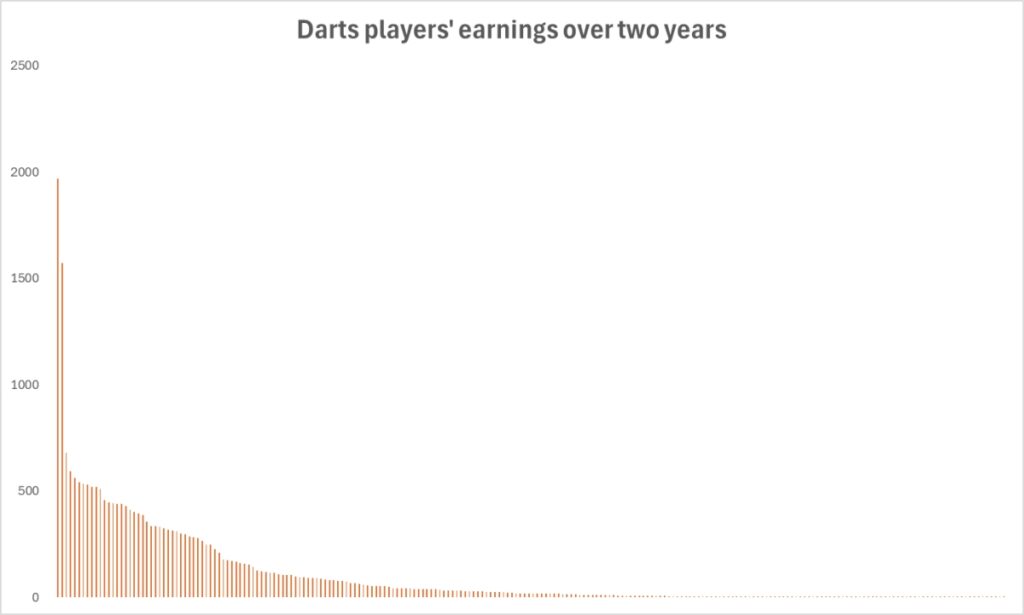
Between 2024 and 2025, the top 20 players in the PDC Order of Merit earned £12.8 million in prize money. The remaining 204 players earned only £10.9 million.
This means that the 20 best players collectively outperformed the rest of the dart players in terms of prize money.
The chart below shows each player’s earnings over the last year. Every bar (line) in the bar chart shows one player.
It illustrates that the players on the left, which represent the best performers, had a significant impact. The ones on the right had nearly no impact.