
The latest data from DebtBusters on household debt shows that South Africans earning more than R20,000 have to spend almost three-quarters of their income paying off loans.
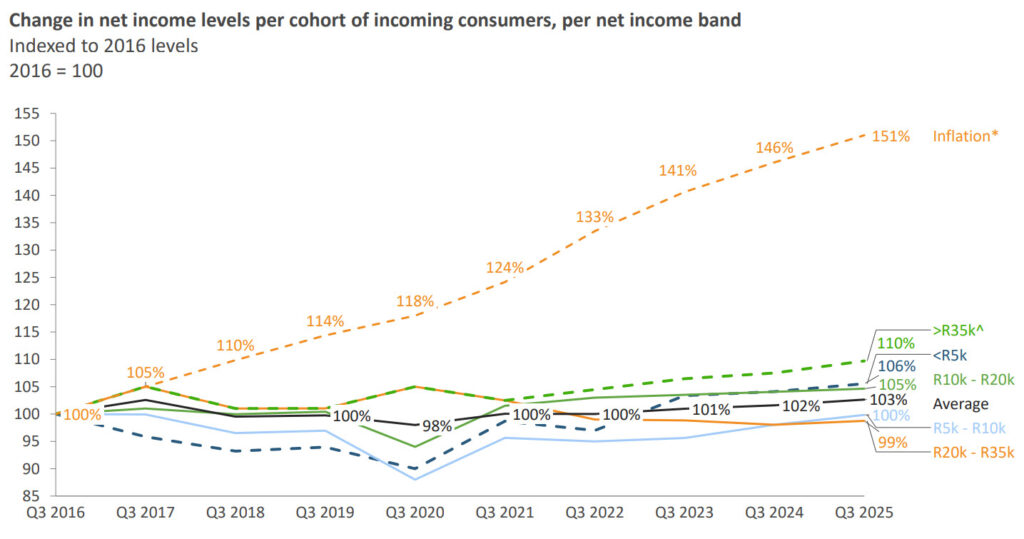
Worse still, salary growth for this band of income earners has declined over the last nine years, while inflation has shot up by 51%.
According to the DebtBusters Debt Index for the third quarter of the year, there has been an increased demand from consumers for debt management.
The group anticipates this demand to increase even further as households face rising costs from administered prices like Eskom’s electricity price hikes and increased municipal rates.
Notably, energy regulator Nersa has allowed Eskom to hike tariffs by 9% in 2026 and 2027, while municipalities like the City of Cape Town and the City of Tshwane are trying to wring extra taxes out of residents through new ‘city cleaning’ levies.
DebtBusters said that 2025 data already points to households buckling under price pressure, with debt levels hitting record highs, particularly among higher-income earners.
Overall, South African households carry a high debt service burden, with 70% of net incomes going towards paying debt on average.
This means consumers need to spend around 70% of their take-home pay to service their debt, which is up sharply compared to the last several quarters and is the highest recorded level since 2017.
Those taking home R35,000 or more per month need to use 78% of their income towards debt repayments, the group noted.
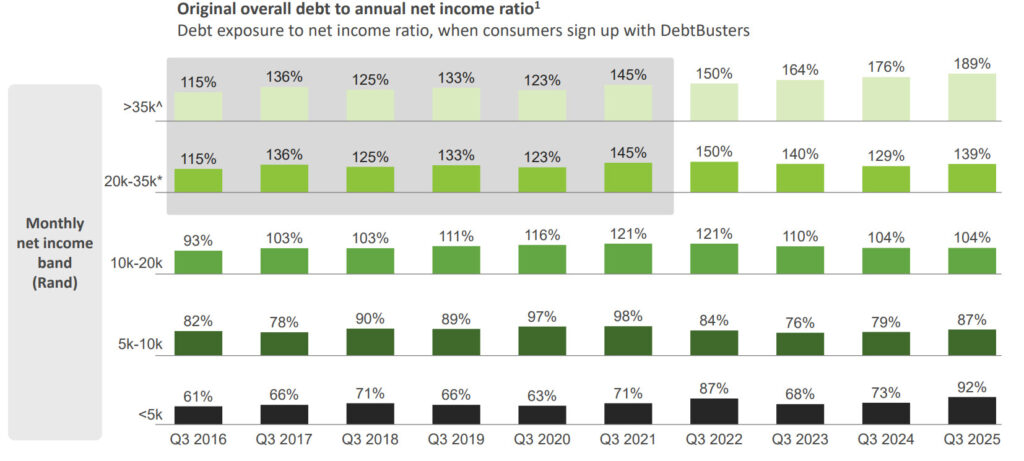
Worryingly, the total debt to annual net income ratio for these top earners is 189% – a record high.
However, the pressure is felt along the entire spectrum, with those taking home R5,000 or less per month—who are the most vulnerable group—needing to use almost their entire income (92%) to service debt.
These ratios are at their highest-ever levels, DebtBusters said.
Spending power is crumbling
One of the driving causes of the financial hardship households are experiencing is the staggering decline in spending power in South Africa.
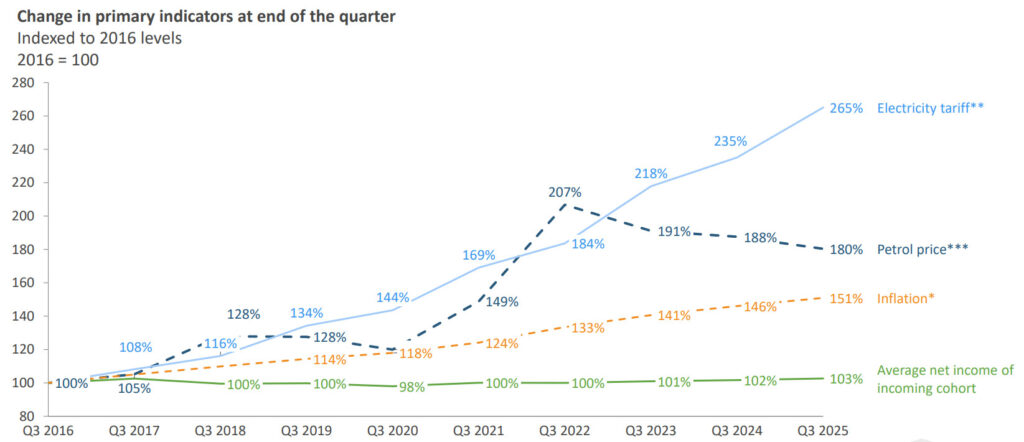
According to DebtBusters’ data, household salaries have 48% less spending power when compared to 2016, with cumulative inflation (CPI) growth of 51% eating away at net income growth of just 3% over the period.
Positively, inflation has subsided, and nominal incomes are slowly recovering. Those earning R35,000 or more have seen incomes increase 10% since 2016, for example.
However, this is not the case for those earning between R20,000 and R35,000, where incomes have declined by 1% compared to 2016.
Considering that fuel prices have risen by 80% over the same period, and electricity prices have increased by 165%, households simply cannot keep up. The fact remains that the money coming in is far lower in real terms.
Unfortunately, this has led many to seek out alternative means of making ends meet, such as turning to credit and taking out loans to get by.
This has seen a worryingly sharp rise in unsecured lending, especially among high-earning households, DebtBusters said.
“Unsecured debt levels were on average 32% higher than 2016 levels. While this is lower than inflation growth, it needs to be viewed in the context of disposable income,” it said.
“For those taking home R35,000 or more, unsecured debt levels were 61% higher. In the context of small salary increases, it signals that consumers still need to supplement their incomes with unsecured credit.”
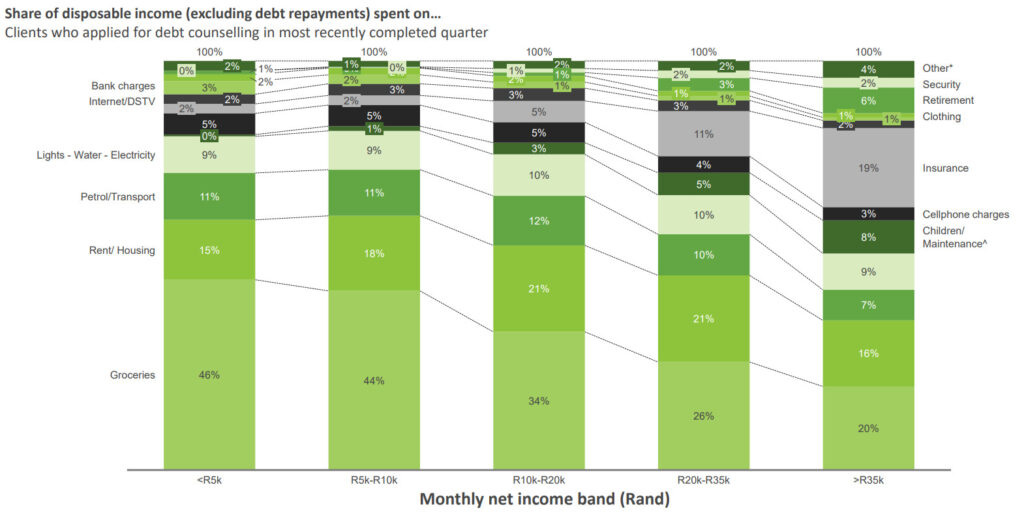
Households are also making sacrifices in other areas.
With around 20% of disposable income—after debt repayments—going to electricity, water, rates,
and transport, and up to 35% going towards food and groceries, there is little left for other essentials.
For lower-income bands, there is little left for expenses such as security, retirement, and childcare costs (including school fees). For higher income bands—R20,000 or more—the cuts are made to things like insurance and retirement savings.