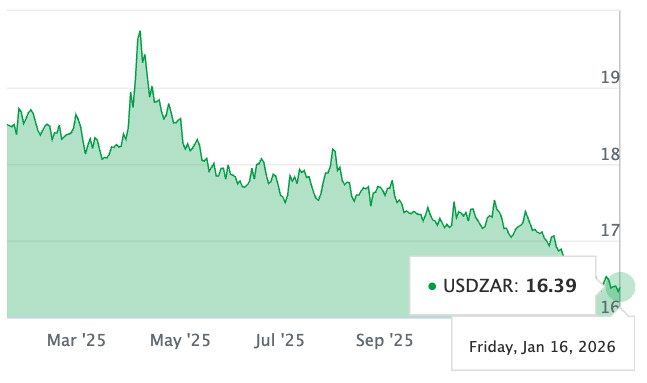

The rand has seen some of its early 2026 gains reversed, with the R16.30/$ resistance level proving hard to beat for the local currency.
The rand has strengthened massively in 2025, but a weaker dollar was primarily responsible.
Investec Chief Economist Annabel Bishop noted that the rand briefly traded at R16.30/USD in the first week of this year.
However, it was quickly rebuffed from the firm resistance level of R16.30/$, which Bishop said requires substantial momentum to pierce convincingly.
Since the start of the year, the rand has gained ground. While the unit strengthened 13.9% against the dollar in 2025, it saw only a sedate 2.5% average strengthening across the year.
So far in 2026, the rand has strengthened by 1.0% against the US dollar, 2.2% against the euro, and 1.6% against the pound, indicating broad gains.
However, Bishop said that the rand tends to strengthen at the start of the year due to seasonally higher risk-taking in the Northern Hemisphere winter.
This contrasts with the northern hemisphere summer vacation period, when risk aversion rises.
“The sell-in-May and go away on holiday period tends to see global markets thinner, as key market players tend to take leave,” she said.
“October often sees churn as market players return, then settle in for the six months, often seeking risk and reward.”
The strength in key commodity prices, including gold and platinum, which have reached new highs, has helped the rand, as these are key exports for South Africa.
That said, international prices of agricultural goods, which are an essential export for the country, are down 2.0% in the new year, following drops last year.
The third category of high relevance to South African exports—vehicles, parts, and components—has seen year-on-year growth in alternative export destinations.
Despite the US imposing harsh tariffs on many parts of the world, the resilience of global trade over the last year has aided worldwide growth and sentiment.
Economic growth a struggle

The South African economy is expected to grow by 1.3% in 2025, with much of the improvement from 2024’s 0.7% driven by the agricultural sector.
While economic growth is expected to pick up in 2026 as well, Bishop said that it will not benefit from the substantial base effects in the agricultural sector that 2025 did.
However, fixed investment growth should support the economy’s performance and the rand.
International events mainly impact the domestic currency, and 2026 is expected to be another year of resilience, with global growth forecast at 3.3%.
The latest figures from the United States show that its GDP grew 4.3% in Q3.25 annualised, with a significant pickup in technology investment and expenditure.
Against this backdrop, however, the rand is also not expected to see the same gains from its current values.
Investec’s purchasing-power-parity valuation of the rand puts it near R16.00/$. At the same time, the Reserve Bank is reported to have been buying hard currency amid a strongly appreciated rand.
The currency has appreciated over the last few years, from its historical low of R20.01/USD in 2023 to R16.31 this year. Movements in 2026 are expected to be more muted.
Bishop said the rand is not expected to gain by nearly R4.00/USD in 2026, but it could see further near-term strength.
However, she warned that several risks remain, with the rand also likely to weaken in Q2.