

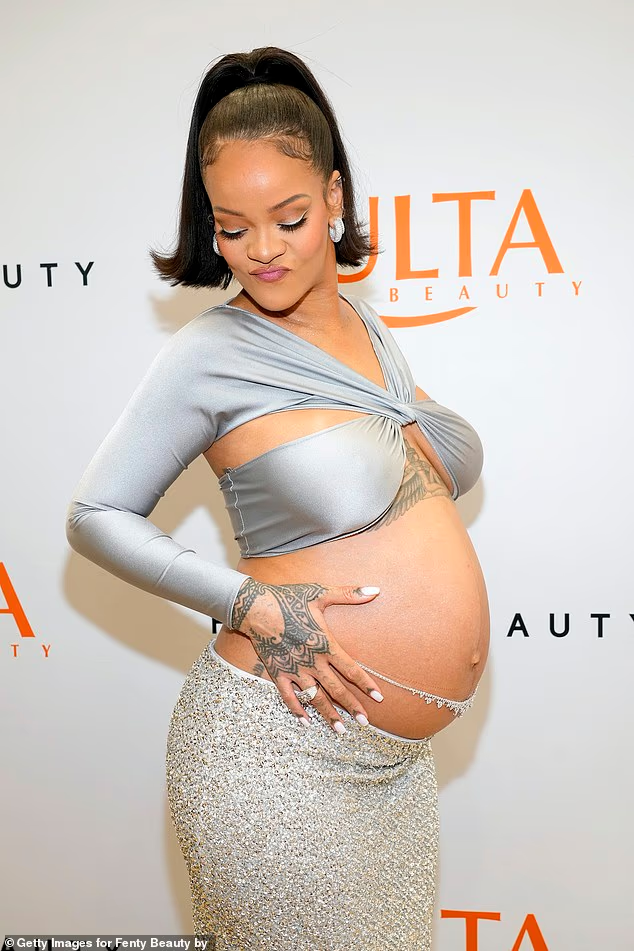
A fashion trend embraced by some of the world’s most high-profile women is being hailed by fans as empowering and unapologetic. From the Oscars red carpet to music awards stages, singers like Rihanna and Beyoncé, and actresses such as Margot Robbie and Sienna Miller, have proudly displayed their baby bumps in form-fitting gowns, cropped tops, and low-slung skirts.
The look leaves no doubt that a baby is on the way, and for celebrities, it often draws praise for celebrating the female body. However, new research suggests that when ordinary women adopt the same style, the reaction can be far less positive—and, in some cases, harmful.
A team of U.S. scientists has found that non-famous pregnant women who choose to bare their bellies are more likely to be dehumanised, objectified, and even judged negatively in contexts where they should feel safe, such as healthcare settings. The findings, published in the academic journal Springer Nature, point to what researchers describe as “unintended consequences” of copying celebrity maternity trends.
Study Finds Only Stars Like Rihanna and Beyoncé Can Escape Stigma of Baring Baby Bumps
The study compared public perceptions of Rihanna—a globally recognised Black singer currently expecting her third child—to two unknown white women. Across her pregnancies, Rihanna has become a poster figure for bold maternity style, wearing skimpy, fashion-forward outfits that leave her growing bump front and centre.
The singer herself has embraced the visibility, once declaring: “I’m hoping that we were able to redefine what’s considered ‘decent’ for pregnant women. My body is doing incredible things right now and I’m not going to be ashamed of that.”
But while the image of a superstar like Rihanna can shift cultural norms, researchers found that the same visual when attached to someone without fame often provokes prejudice. “In all three studies, the woman revealing her pregnant belly was lower in perceived humanness,” the authors wrote. “These perceptions contributed to the belief she would be an unfit mother and should be denied financial support.”
The experiments presented participants with images of pregnant women—some baring their bumps, others dressed more conservatively—and then asked respondents to assess their impressions. The results were consistent: celebrity status shielded women from the most damaging judgments, while anonymity left them vulnerable to bias.
This bias was not limited to casual opinion. According to the researchers, the dehumanisation effect could influence how women are treated in professional or clinical settings. Negative assumptions about “fitness for motherhood” could, for example, affect interactions with healthcare providers, social workers, or government agencies.
The researchers suggest that celebrity culture plays a double-edged role. On one hand, stars like Rihanna and Beyoncé can inspire more women to embrace their bodies during pregnancy and reject outdated notions of modesty. On the other, their privilege and visibility allow them to avoid the stigma that ordinary women may face for making the same fashion choices.
Beyoncé, who also embraced glamorous, belly-baring maternity looks during her pregnancies, has spoken in the past about celebrating her body’s transformation. Likewise, Margot Robbie and Sienna Miller have made headlines for stylishly flaunting their bumps on red carpets. These moments are often celebrated in glossy magazines and fashion blogs as examples of confidence and empowerment.
But for women without celebrity status—or without the protective halo of wealth, fame, and curated public relations—the response can be sharply different. While celebrities may receive admiration and brand endorsements, others may encounter gossip, judgment, or even professional repercussions.
The researchers warn that social media may be amplifying the problem. Platforms like Instagram and TikTok, where celebrity maternity images are widely shared, create a feedback loop that encourages imitation but doesn’t account for the social penalties faced by everyday people. The result, they say, is a widening gap between public perception of famous and non-famous women making identical style choices.
Some advocates for women’s rights say the findings should spark broader conversations about how pregnancy is viewed in society. They argue that the policing of women’s bodies—especially during such a personal and transformative time—reflects deep-rooted biases that need to be challenged, whether the subject is a pop star or a shop assistant.
For Rihanna, the bump-baring trend is about reclaiming ownership of her image. She has said that her maternity style choices are about rejecting the idea that pregnancy must be hidden under oversized clothing or reduced to a “pure” aesthetic. “If I’m feeling sexy, why not? I don’t stop being me because I’m pregnant,” she told one interviewer.
The study’s authors acknowledge that celebrity influence is complex. While famous figures can open cultural space for new expressions of femininity and motherhood, their personal immunity from negative consequences means that ordinary women bear a disproportionate share of the risks.
Their conclusion is clear: when it comes to breaking pregnancy fashion norms, star power matters—not just for who sets the trends, but for who can safely follow them.
Source- Dailymail
