


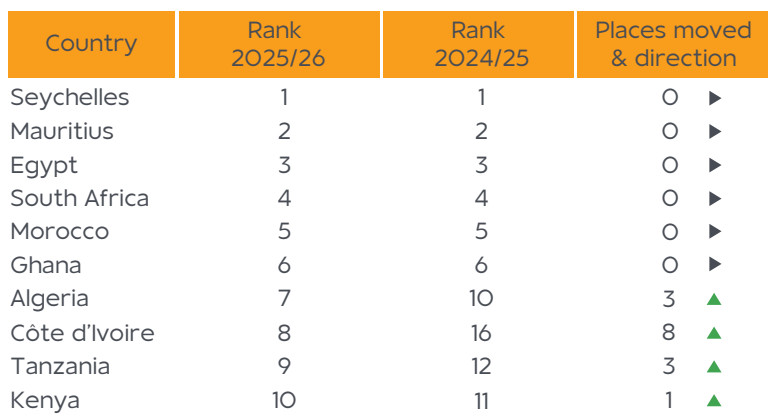
Seychelles and Mauritius retained their ranking as Africa’s most attractive investment destinations, outperforming larger economies, including Egypt, South Africa and Morocco, according to a report published on Monday on Where to Invest in Africa from lender RMB.
The two Indian Ocean island nations stood out in a year marked by significant geopolitical shifts including US trade tariffs and policy changes stemming from a number of elections across the region, RMB chief economist Isaah Mhlanga told an event to launch the report in Johannesburg.
“Episodes of unrest and policy uncertainty, and the global fracturing and reorientation have all had measurable macroeconomic effects,” Mhlanga said in the report.
“Changes in the political and the subsequent policy environment and declining foreign aid, coupled with the redirection of global capital flows, are reshaping how African economies engage with the world.”
The index, compiled by RMB and the Gordon Institute of Business Science, ranks 31 African countries according to gross domestic product and potential performance, market accessibility and innovation, economic stability and climate investment, as well as social and human development.
Top world cocoa producer Ivory Coast was the country whose ranking advanced the most, moving into the top 10 from 16th place, thanks to its widening access to electricity, government efforts to broaden exports and a focus on domestic processing.
Ivory Coast “has been serious about repositioning its industrial composition, moving up eight places,” Adrian Saville, professor of economics at GIBS said.
Conversely, Nigeria showed the biggest drop, falling nine places from the prior year even as President Bola Tinubu’s measures to reform the west African economy took hold.
He phased out costly fuel subsidies and loosened currency controls, which drew praise from international investors but sparked domestic anger by fanning inflation.
Though South Africa, the region’s most industrialised economy, retained its place in the rankings, it is “stuck,” Saville said.
“What we need to happen for us to get from neutral into first is for investment confidence to be restored.”
The African National Congress entered into an uneasy coalition with its main rival, the Democratic Alliance and eight smaller parties after losing its parliamentary majority in last year’s elections.
But the so-called government of national unity has struggled to act decisively on major issues, RMB said.
South Africa needs to shift gears
With a score of 0.31, South Africa maintained its fourth position in the ranking, with RMB noting that the exit from the Financial Action Taskforce (FATF) grey list will likely bring positive changes for the country going forward.
However, “South Africa is economically stuck,” the group said.
“The country’s GDP size may be Africa’s largest, but GDP growth is likely to be the continent’s lowest for 2025 at around 1%, and very nearly the lowest on average to 2029, at around 1.5%.”
Among the various pillars and metrics, South Africa ranked very poorly in terms of growth structure and growth forecast, as well as in terms of population growth and income inequality.
This reflects that country’s struggle to grow the economy while the population increases, resulting in a declining GDP per capita—citizens getting poorer—and further concentration of wealth at the top.
The exit from the FATF grey list is seen as a positive move, however, with capital allocators and business operators likely to benefit in 2025 and 2026.
However, business leaders have noted that this isn’t the end of South Africa’s fight to restore its global reputation.
According to Business Leadership South Africa (BLSA) CEO, Busi Mavuso, getting off the list should be a point of reflection for the country, especially when looking at why it got onto the list in the first place.
From there, the government, authorities and businesses need to continue working to not end up in that position again.
“The FATF exit offers a template for how we should approach other critical reforms. We must have clear, measurable targets, no moving goalposts, and the test of success must be about effectiveness,” she said.
“There must be proper accountability and transparent reporting on progress.”
Mavuso said that the exit from the FATF has proven that South Africa has the capability to make important policy reforms and address the country’s critical needs.
However, it needs consistency to turn this into long-term results, and to draw investors back.
“Reputation is built on consistent delivery. The FATF exit must be followed by continued progress on economic reforms, infrastructure investment and improved state capacity,” she said.
(With Bloomberg)
