
Provincial governments spend most of their funding on staff costs, with the Eastern Cape spending the largest share of its expenditure on compensation for state employees.
A recent study from Stats SA explored how provincial government wage bills provide insights into how an essential sphere of government spends money.
Provincial governments provide essential services, from education and health to infrastructure development.
Stats SA said that government expenditure can be classified in functional and economic terms, with the former mainly linked to services that the government provides.
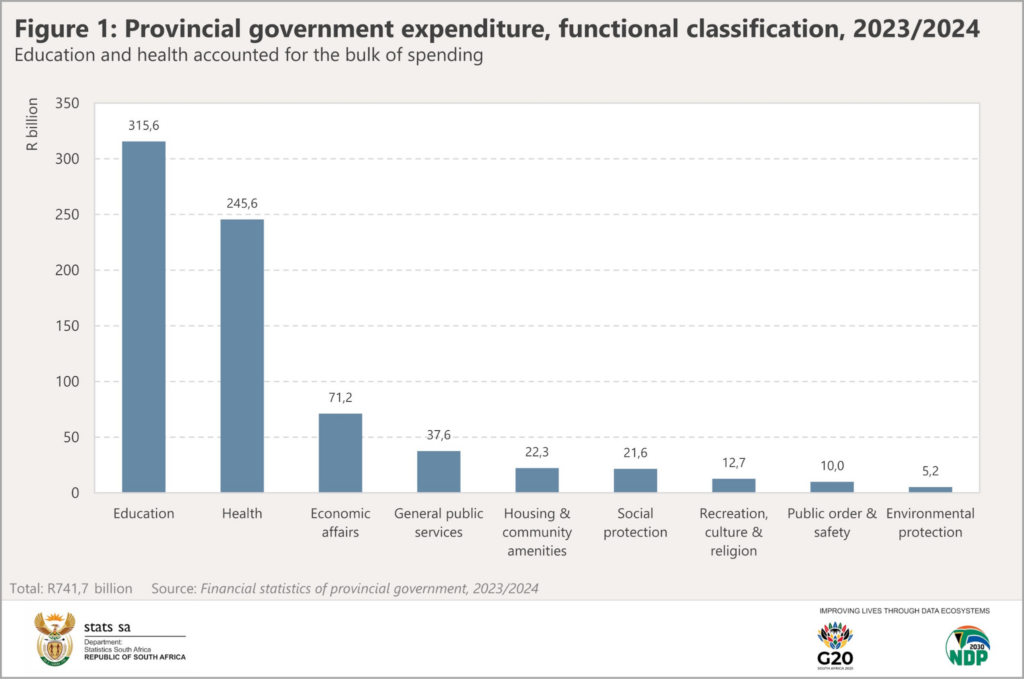
When it comes to provincial governments, spending is dominated by education and health.
These two functions account for R561 billion (76%) of provincial government expenditure, according to the latest Financial Statistics of Provincial Government Statistical Release.
Education accounts for R315 billion of all spending, while healthcare stands at R245 billion. Economic affairs is in a distant third place, which sits at just R71 billion.
Not a single other line of expenditure hits over R40 billion, with housing and community amenities sitting at just R22 billion.
Stats SA said that expenditure is classified according to the nature of the transactions involved.
Compensation of employees and purchases of goods & services are the line items that take up the largest amounts.
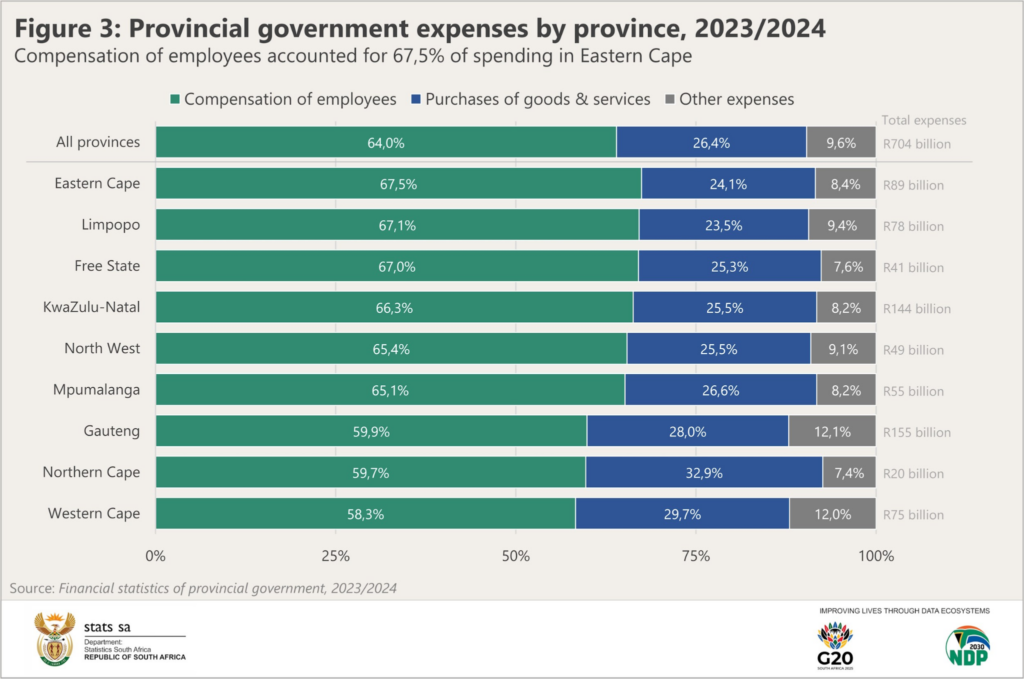
In the 2023/2024 financial year, provincial government expenses reached R704 billion.
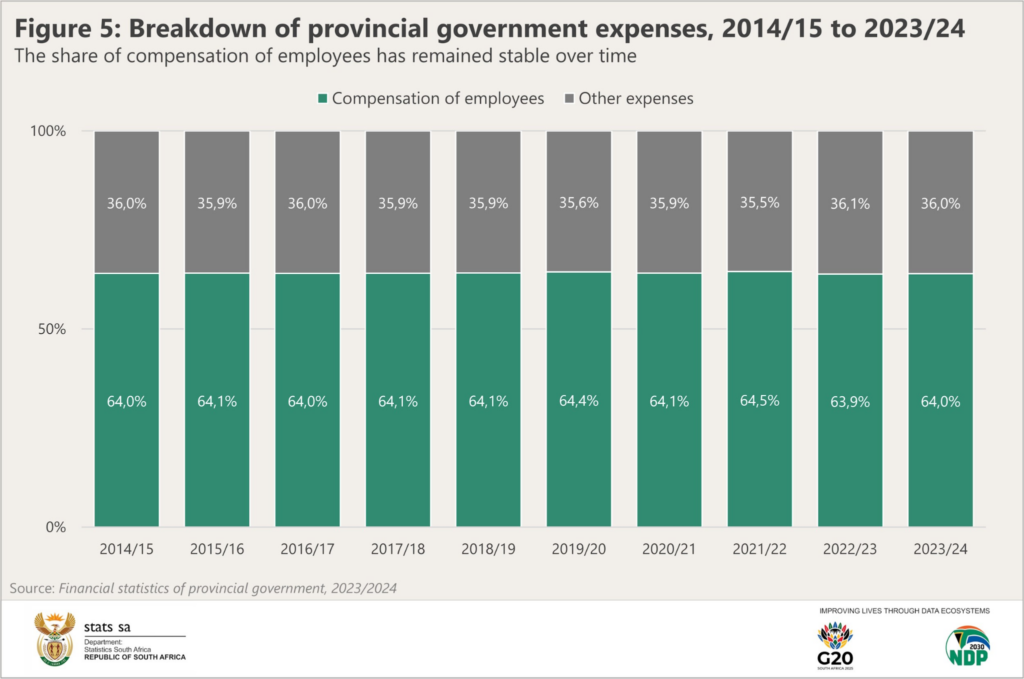
Compensation of employees was the main cost driver, accounting for 64.0% of all expenditure. This was well ahead of the purchases of goods and services at 26% in second place.
Looking at specific provinces, the Eastern Cape provincial government recorded the largest percentage of compensation of employees to total expenses.
Limpopo and Free State followed closely, with compensation accounting for 67.1% and 67.0% of total expenditure, respectively.
KwaZulu-Natal, North West, and Mpumalanga also spend over 65% of their expenditure on compensation of workers.
On the other end of the scale, Gauteng, Northern Cape and Western Cape all spend less than 60% their expenditure on compensation.
These three provinces spend larger shares of their total expenditure on purchases of goods and services and other expenses.
Who gets the largest slice
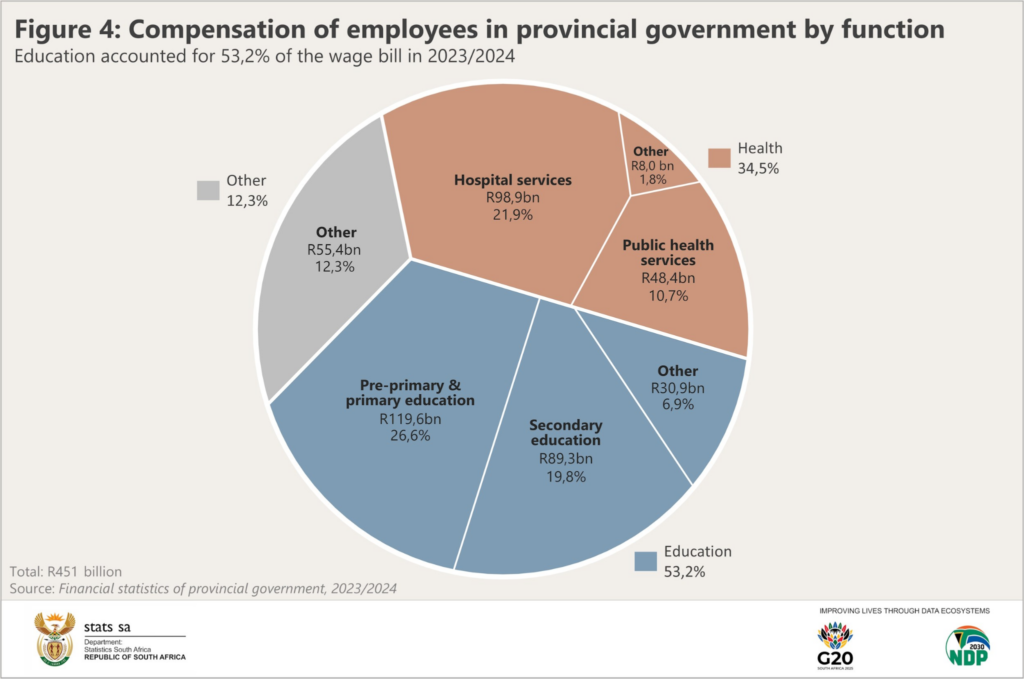
Looking deeper at the figures, Stats SA provided a breakdown of the R451 billion spent on employees by function.
Over half was paid to civil servants working in education, with R120 billion (27%) spent on pre-primary and primary education and R90 billion (20%) spent on secondary education.
Staff in hospital services receive R99 billion (22%), while public health service staff earn R48 billion (11%).
“Education and health are the two leading responsibilities of the provincial government,” said Stats SA.
“These two mammoth tasks require a large number of teachers, education personnel, nurses, doctors and health care workers.”
Stats SA noted that the provincial government’s wage bill has grown from R271 billion in 2014/2025 to R451 billion in 2023/2024.
This equates to an annual growth rate of 5.8%, lower than the annual growth rate of 7.4% for purchases of goods & services (R98 billion to R186 billion).
The total share of compensation to total expenses over the period also remained within a range of 63.9% to 64.5%.