

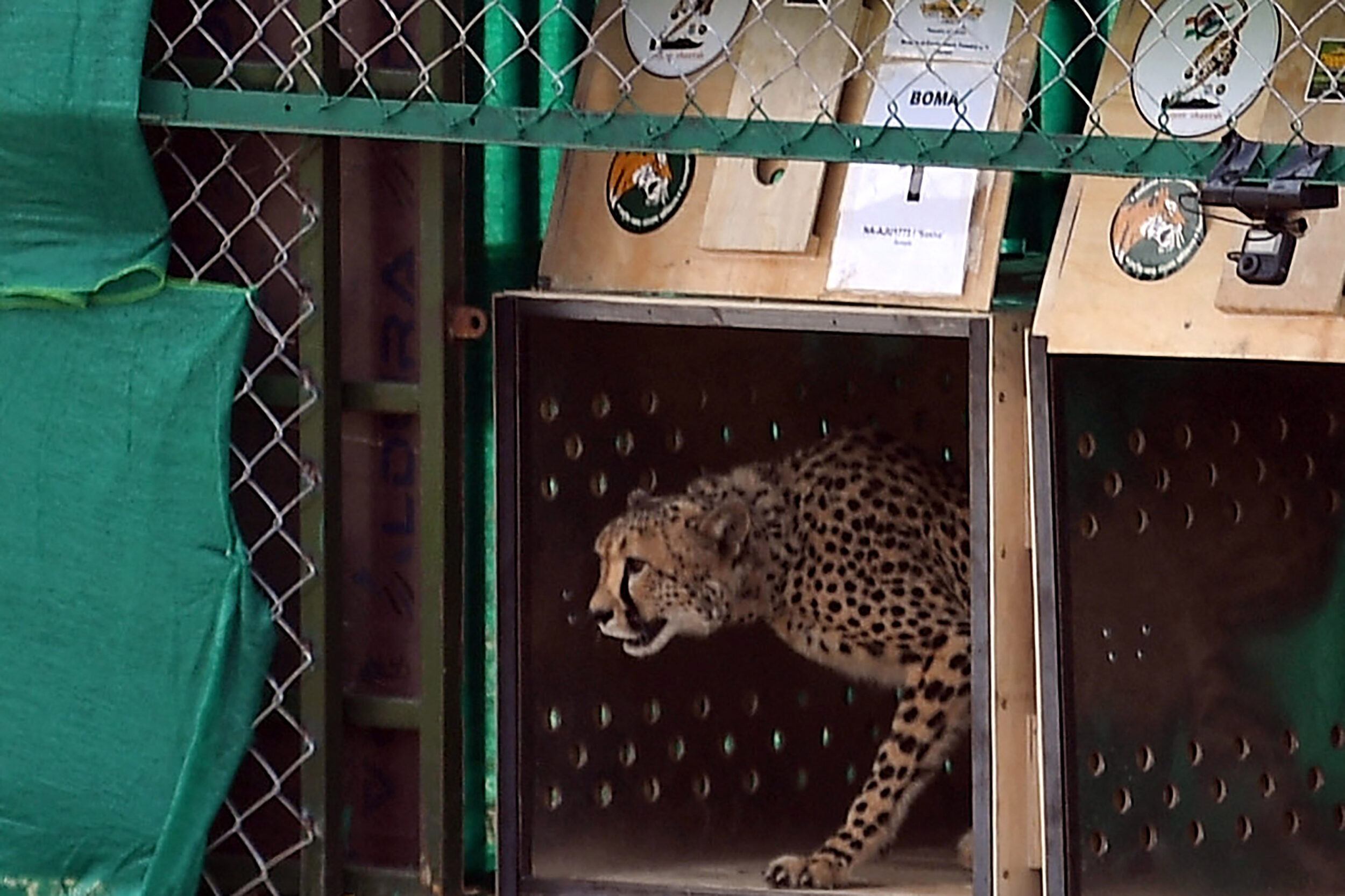
The death of six-year-old male cheetah Uday has sparked global concern of translocating endangered species, but experts have argued that although there were some complications and challenges, cheetahs were adaptable animals and translocation was not the reason he died.
Uday is the second cheetah from Africa to die in India’s Kuno National Park in the central state of Madhya Pradesh, while four out of six endangered black rhinos which were relocated to Chad in 2018 from SA died of possible starvation.
Uday’s cause of death unclear
Although the cause of Uday’s death remained unclear, Adrian Tordiffe, an associate professor of veterinary pharmacology and veterinary wildlife specialist at the University of Pretoria, said it was likely botulism – caused by ingestion of bacteria.
“At this stage we haven’t seen the post-mortem report, but I’ve been told the cheetah had congestive heart failure,” he said.
“It’s something we’ve seen in SA in captive cats [such as] lions and leopards … we’ve seen several cases. The source is difficult to identify in some cases, it could be from the water source.
“So, if an animal has died in the water source, the bacteria would multiply anaerobically in the carcase of the dead animal and then they would produce this toxin, which then can be ingested from the water.”
Adaptation struggles
Tordiffe said in South Africa, the animals normally became paralysed or lame, although many recovered with appropriate supportive treatment.
“The difficulty with this toxin is, it is quite difficult to diagnose because isolating the toxin in [Uday’s body] is quite difficult.”
Critics have warned the creatures may struggle to adapt to the Indian habitat due to competition for prey from a significant number of leopards.
Cheetah management
Cheetah Metapopulation Project in Southern Africa manager Vincent van der Merwe said cheetahs were incredibly adaptable animals.
“We move them across SA all the time from savannah habitats to grassland habitats in the Free State and desert habitats in the Kalahari to tropical forest habitats in Zululand”.
“The limiting factor for cheetahs is management,” said Van der Merwe.
“Good management, good fences and good monitoring. Now the one thing that India does not have is fences around its game reserve.”
WATCH: Sudan’s animals in danger amid ongoing conflict and power cuts
Political support
Endangered Wildlife Trust’s Derek van der Merwe said the organisation pulled out of the project because it was rushed and posed a number of concerns.
Vincent van der Merwe said due to a court ruling from India in 2020 that the species should be reintroduced, “they jumped at the opportunity”.
“There’s a lot of factors at play here. India’s been trying to get political support to reintroduce cheetahs since the 1960s, so when they got the opportunity and they got approval from the government and from their supreme court, they jumped at that opportunity,” he said.
